Motown VF — 1964: The British Beat and Barclay
BY PAUL HUNTER
The New Year opened with the British Beat making waves in France, especially with the rapturously received Beatles’ three-week appearance at Paris Olympia, televised by ORTF and broadcast on Europe 1 Musicorama.
Decca Records were building on Brian Poole & the Tremeloes’ successful introduction to France at the same venue in November 1963. Their five-song set included the British hit cover version of the Contours’ “Do You Love Me,” subsequently the title of a French EP on Decca. In the U.K., Decca was exploring the Motown songbook with artists such as Beryl Marsden, Doug Sheldon, and Bern Elliott & the Fenmen, who accompanied the Beatles at Olympia.
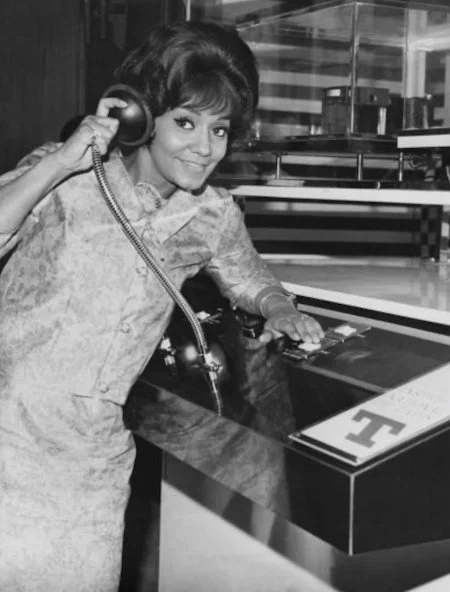
Nancy Holloway: from Cleveland to the City of Light
While “Do You Love Me” attracted limited attention in France, Decca took on a Motown VF (“version française”) for their French-based African-American artist Nancy Holloway. Cleveland-born Holloway came to Paris from the U.S. in 1954 to escape an abusive teenage marriage. She established herself as a singer in local jazz clubs and across Europe, later headlining at the Moulin Rouge, alongside visiting Americans. After signing with Ricordi France in 1961, she moved to Decca in 1963. Later that year, she hit with T’en Vas Pas Comme Ca, a French-language adaptation of Dionne Warwick’s “Don’t Make Me Over.”
Her third Decca EP contained Est-ce Que Tu M’aimes? (“Do You Love Me”), one of two Pierre Saka versions of the song. Holloway’s spoken introduction comes from Jean de la Fontaine’s 1668 fable La Cigale et La Fourmi (“The Cicada and the Ant”). Its closing line – Eh bien, dansez maintenant! (“Well, dance now!”) – cues the song.
She sings mainly in French but retains a verse in English from the Berry Gordy-authored original. Saka’s lyrical adaptation turns the song into a dance-floor encounter. Holloway tries to please her partner much as the cicada tries to satisfy the ant. Her voice grows raw when she cuts to the chase demanding Est-ce que tu m’ai — mes? holding the last word for emphasis. Like the fable, it closes without resolving whether she succeeds.
Decca released the song as part of its Spécial Copains series. This was aimed squarely at the booming Salut les Copains radio and magazine market. Its February 1964 release coincided with Holloway appearing as herself in the Cherchez l’Idole film alongside Johnny Hallyday, Eddy Mitchell, Sylvie Vartan and Charles Aznavour, in a star-studded cast. A Jukebox 45 release followed and the song also appeared in Belgium and Canada, and was later recorded by Montréal trio, Les Baronets.
Saka also wrote a second adaptation, C’est Comme Ça, Dis (“That’s How It Is, I Say”), which was recorded in Paris by two Flemish artists. Jimmy Frey’s version, arranged by Jacques Denjean, appeared on Philips’ Fontana label in France and Spain. Pathé-Marconi, with the ink barely dry on the new EMI Motown license deal, chose to issue the other version, by Burt Blanca et ses Guitares Magiques, via La Voix de son Maître (HMV). This appears to have been Pathé-Marconi’s first Motown VF. Significantly, it appeared before the original Contours’ version, which did not receive a French release until a late-1965 EP, Jerk With The Contours. Neither adaptation attracted much commercial attention.
A VOICE BREAKING, AND A HEAD COLD
Eddie Barclay continued pushing Motown. February brought Little Stevie Wonder’s third French EP containing his pre-“Fingertips” 45, “La La La La La,” alongside three tracks from his U.S. album, Recorded Live/The 12-Year-Old Genius. Wonder’s French star had faded after his disappointing December 1963 Olympia appearances, falling down the bill behind Dionne Warwick and the Shirelles. His breaking voice and a head cold were blamed. However, the absence of a strong follow-up to “Fingertips,” and reliance on older material, hardly helped.
Barclay then broke through with two Motown VF hits. Eddy Mitchell picked up on the French success of the Les Beatles LP and adapted one of its three Motown songs, “Money (That’s What I Want).” His version, Pas de Chance (“Bad Luck”), was recorded in London with the London All Stars +5, including Big Jim Sullivan.
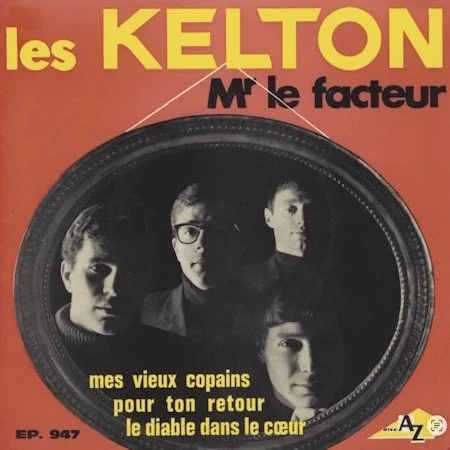
Inspired by Les Beatles: a French ‘Postman’
The London-style rock arrangement keeps the aggressive drive of “Money,” while softening some of its rawness. The lyric turns the original song’s obsession on its head in the manner of a French farce. Mitchell mocks his friend who gets drunk and completely loses his way, ending up marrying an “ugly” girl who has no money at all. Pas de Chance was a Top 5 hit and appeared on a French EP, Jukebox 45 and his Panorama LP. Barrett Strong’s original version, by contrast, was not issued in France until 1973.
Marvin Gaye’s “Can I Get A Witness” had been released elsewhere in Europe, but not in France by Pathe-Marconi until early 1965, and then only as the last track on both a compilation LP, The Big, Big Sound from Detroit, and an EP. In March of ’64, Barclay singer-songwriter Jacques Buliston, better known as Monty, filled the gap with his version of “Witness,” Un Verre de Whisky. Jacques Loussier gives it a jazz-orchestral treatment which retains the drive of Gaye’s recording. New Paris resident Mort Shuman, of Pomus/Shuman songwriting fame, contributed to the writing.
Monty transforms Gaye’s gospel-led plea for a witness to his suffering where the church disappears. Abandoned by his lover, Monty wants no prayers and drowns his sorrows in whisky. The result is knowingly tongue-in-cheek, and despite RTF censorship due to its alcohol references, it became a Top 10 hit, appearing on both EP and Jukebox 45.
Beatlemania provided further Motown VF expression through the close relationship of Salut les Copains, Europe 1 and Disc’AZ. The radio station and record label shared ownership, management and Paris-premises. Lucien Morisse acted as Disc’AZ’s managing director and Europe 1’s director of programming.
A CIRCUS ACT DELIVERS
Disc’AZ artists consequently benefited from substantial radio exposure. Among them were Les Kelton, a four-piece modelled on the Beatles and frequent recorders of Beatles’ VF. Their first EP was headed by Jean Dellème’s Mr Le Facteur, an adaptation of the Marvelettes’ “Please Mr. Postman.” This was another Motown song introduced to France through the Les Beatles LP. Europe 1 promotion helped the record onto several charts as noted in Jukebox magazine’s retrospective.
Henri Salvador’s long-term collaborators, Maurice Pon and Bernard Michel, wrote Motown adaptations for two female artists on his label. German-born Audrey had come to France as part of her father’s circus act. She recorded Ce Merveilleux Garçon, an adaptation of Mary Wells’ “You Lost The Sweetest Boy,” immediately following the original’s appearance on Wells’ 1963 EP. Christian Chevallier arranged Maurice Pon’s adaptation at the Studio Europa Sonor.
The second song came from Tiny Yong, whose parents took her from Vietnam to France in 1958. Salvador replaced her original name, Thien Huong, considering it more marketable. She quickly became a “preferred” singer on Salut les Copains radio. Her fifth EP included Il Reviendra (“He’ll Return”), Bernard Michel’s adaptation of a Marvelettes’ B side, “Little Girl Blue.” Her sweet, optimistic insistence that her lover will return is contradicted by the call-and-response backing voices telling her that he won't.
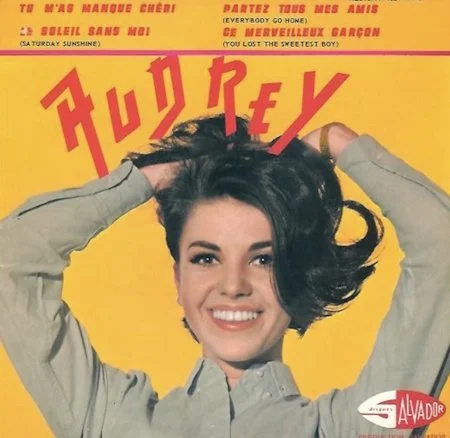
Audrey: another ‘Boy’ lost
Pathé-Marconi came to life in May 1964 with an EP showcasing Marvin Gaye, led by his current U.S. release “You’re A Wonderful One,” issued on Columbia under the Presénce Mondiale series. The inclusion of jazzy live versions of “Stubborn Kind Of Fellow” and “Pride And Joy” from his U.S. Recorded Live On Stage album gives the release a rather different pitch from the youth-oriented Motown VF appearing around it.
An early 1964 Motown VF appeared as Greek-born Fia Karin recorded André Salvet’s Ça Brûle, an adaptation of Martha & the Vandellas’ “Heat Wave,” popularised by a Columbia EP in late 1963. Published on the small Week End label, the song was arranged by the African-American guitarist, Mickey Baker, another recent Paris arrival. Despite Baker’s involvement, the song has an unexpectedly fairground-organ feel with Fia’s French diction difficult to follow. Week End had further language difficulties as the label identifies “Heat Wave” as “It Wave.”
The artists making these records were also meeting on the French live circuit. Eddy Mitchell and Nancy Holloway toured together during the spring, including appearances in Lyon, while Cherchez l’Idole, featuring both, was circulating in French cinemas. On 21 April, they were the featured artists at an Olympia concert whose first half also included Les Kelton and Fia Karin. Mitchell's Pas de Chance and Les Kelton's Mr Le Facteur were current releases.
Thus, by the middle of 1964, Motown was beginning to make headway in France, but not simply through the Detroit recordings themselves. British versions provided one route, while French adaptations could precede the release of Hitsville U.S.A. originals and circulate through an interconnected world of records, radio and live performance. Some were already travelling onwards to Canada.
To the benefit of Jobete Music, the output of Hitsville U.S.A. was becoming established in France before Motown Records itself had acquired the same visibility.
Paul Hunter is a researcher and collector specialising in the international history of American popular music, with a particular interest in Motown. His current research examines how Motown recordings crossed linguistic, cultural and industrial boundaries to become part of French and Francophone popular culture during the 1960s. Paul’s first WGB guest article can be found here, while the above is the first of two pieces about Motown “version française” in 1964. The second will follow soon. In addition to the YouTube links on seven of the tracks listed below, there is a WGB playlist to be found here; it’s rather modest because much of the repertoire doesn’t appear to be available on Spotify. Meanwhile, should you be interested in Motown’s fortunes in another European nation, there’s this WGB edition. Et maintenant…
SELECTED MOTOWN VF 1964 DISCOGRAPHY:
Audrey, “Ce Merveilleux Garçon” (“You Lost The Sweetest Boy”)
EP: Salvador 432998; 45: Salvador B 373.226
Les Baronets: “Est-ce que tu m’aimes?” (“Do You Love Me”)
45: Franco F-9347; LP: Trans-Canada TF 332 (both Canada)
Burt Blanca et ses Guitares Magiques: “C’est comme ça, dis” (“Do You Love Me”)
EP: La Voix de son Maître EMF 337
Eddy Mitchell: “Pas de Chance” (“Money (That’s What I Want)”)
EP: Barclay 70646; 45: Barclay BLY 60483; LP: Panorama, Barclay 80227
Fia Karin: “Ça Brûle” (“Heat Wave”)
EP: Week End WE 8004
Jimmy Frey: “C’est comme ça, dis” (“Do You Love Me”)
EP: Fontana 460 884 (both France and Spain with individual local sleeves)
Les Kelton: “Mr Le Facteur” (“Please Mr. Postman”)
EP: Disc’AZ 947
Monty: “Un Verre de Whisky” (“Can I Get A Witness”)
EP: Barclay 70649; 45: Barclay BLY 60482
Nancy Holloway: “Est-ce Que Tu M’aimes?” (“Do You Love Me”)
EP: Decca 460 830; 45: Decca 70951 (both France and Belgium with individual local sleeves)
45: Copains CP-116 (Canada)
Tiny Yong: “Il Reviendra” (“Little Girl Blue”)
EP: Salvador 434 830; 45: Salvador B. 373.279