The Legacy of Loucye
AN INVESTMENT WHICH CHANGED LIVES, A BALL TO CELEBRATE
Philanthropy is hardly the first word which comes to mind when musing about the music industry. And yet…
More than a half-century ago, dozens of Michigan youngsters had their lives shaped and changed thanks to the creation of the Loucye Gordy Wakefield Scholarship Fund.
One of them was Brenda Boyce.
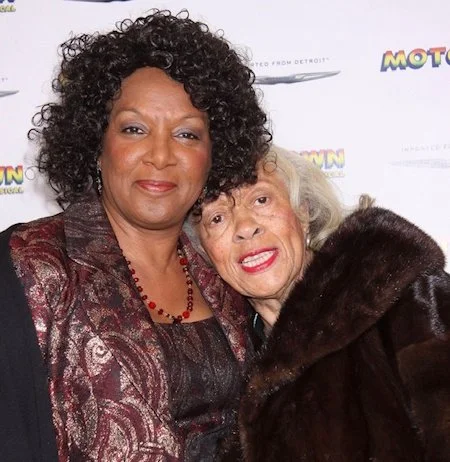
Brenda Boyce (left) with Faye Hale at the Broadway opening of Motown The Musical
“My mother could not afford for me to go to college – and I was determined to go.” That ambition became reality when Boyce learned that the scholarship fund created to honour Berry Gordy’s late sister would help to finance her higher education.
There was more excitement to come: an invitation to the first Sterling Ball, held at the opulent Gordy mansion in Detroit on Saturday, October 4, 1969, to raise money for the grants.
“I heard that all the Motown artists would be there and the ‘who’s who’ of Detroit,” says Boyce, who had been working at Michigan Bell that summer. “I believe I spent one week’s check on an outfit. I wanted to look the best I could, standing in a receiving line greeting the best of Motown and Detroit.”
The Sterling Ball was, indeed, a mirror of the Motor City at its best. During the three years in which it was held – 1969, 1971, 1972 – the event raised at least $150,000 (equivalent to more than $1 million today) for the scholarship fund. This was established via the Gordy Foundation in 1968 in memory of Wakefield, whose premature passing had occurred three years earlier. (An account of her life can be found in this West Grand Blog edition.)
“In 1969, I was in my senior year at Southeastern High School,” Boyce recalled for me recently, “a straight ‘A’ student all or most of my years there and a member of the National Honor Society (NHS). I had wanted to go to Michigan State or move to California to stay with my aunt and attend UCLA.
“One afternoon, the NHS approached me about a scholarship being awarded for underprivileged Detroit inner-city students by the Gordy Foundation. It was in partnership with a community development company, for which I don’t remember the name, and it was only for attendance at Wayne State University. I was familiar with Motown, because my brother, five years older, would always run out and buy any new record by the Temptations, the Miracles and other acts. I loved Motown, too, especially the Supremes. I could sing but didn’t have any real desire to pursue that path.”
‘I COULD NOT BELIEVE IT’
Boyce had wanted to go to another college, but the honour of support from this organisation “meant so much more.” There were ten students who earned the scholarship, “and we all attended a luncheon with the community development company, where we received the award plaque.
“That luncheon was also where I met Mrs. Bertha Gordy, Mrs. Esther Gordy Edwards and Fay Janet Hale, who were all part of the Gordy Foundation. By this time, I had graduated – fourth in my class.” Then came the invitation to the Sterling Ball. “What!? I could not believe it.”
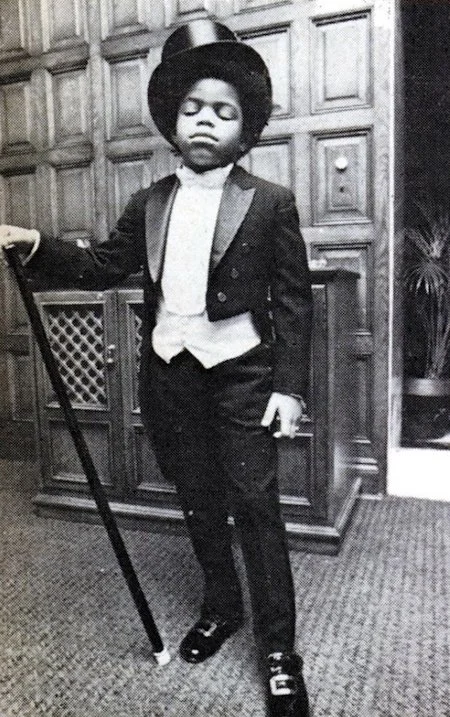
Kennedy Gordy (later, Rockwell) at the ball, aged seven
The extravaganza was scheduled to take place at the Berry Gordy mansion on Detroit’s Boston Boulevard – which promptly elevated the media coverage. “The Magnificence of the Berry Gordy Home,” ran the headline over a Detroit Free Press article, complete with photographs. “The magnificence starts in the marble foyer with its travertine walls and carved arches,” while the “dining room ceiling beams are hand-painted in deep golds, reds and blues.” It added, “An Olympic-size swimming pool has tiles which portray tropical fish, each one different.” The newspaper also noted that the restoration and interior decoration of the 40-year-old manor was directed by Anna Gordy Gaye. On the evening of the ball, her husband, Marvin, performed for the guests.
“We were allowed to bring a parent,” continues Boyce, “but my mother did not want to go. The great honour for me was for my uncle to attend, who was really like my father. He knew all about Motown, and I think he was more excited than I was. Everybody was sharp: the Gordy sisters in beautiful flowing gowns, the men in tuxedos, the mayor, council people, club owners, Ford family members. It was amazing.
“All of us scholarship recipients were in a receiving line, and Mr. Gordy came through the line, smiling, in a beautiful brown tuxedo, congratulating us – as did many of the artists and dignitaries. I felt like I was meeting a king.”
Or an emperor? Boyce remembers that on the wall of one of the guest-filled rooms was a painting of Berry Gordy, portrayed as Napoleon Bonaparte. Indeed, the unveiling of that work was one of the ’69 Sterling Ball’s surprises. “Mrs. Gaye kept telling people not to leave,” reported the Detroit Free Press, “until she had manoeuvred her brother into a room where [artist DeVon Cunningham] unveiled a painting of Gordy, his eyes imperious in a look of command, as a black Napoleon. Berry took one incredulous look and broke into peals of laughter.”
Guests took away more than such moments to treasure. At the first and second editions of the ball, they were given albums as souvenirs: in 1969, it was the previously-released In Loving Memory, a compilation of Motown acts singing traditional gospel songs, including “The Lord’s Prayer” (the Temptations), “Swing Low Sweet Chariot” (Stevie Wonder), “His Eye Is On The Sparrow” (Marvin Gaye) and “He” (Diana Ross & the Supremes).
In her memoir, former Motown tape library director Fran Heard noted that the custom cover for the LP included the names of sponsors, patrons and contributors, plus the dinner menu. She also recalled being introduced there to the Jackson 5 (“who were just boys then”). “The few hours that I spent in the atmosphere of the fabulous gala at the ball, and the rubbing of elbows with the elite guests, left me with memories that I shall always cherish.”
DIANA AND BILLY AS CO-CHAIRS
At the second Sterling Ball on April 24, 1971, the souvenir LP was a ten-track assembly, including Marvin Gaye’s “What’s Going On,” Stevie Wonder’s “Heaven Help Us All,” Smokey Robinson & the Miracles’ “I Care About Detroit” and Earl Van Dyke’s “Someday We’ll Be Together.” Van Dyke led a band which played at the ’71 and ’72 celebrations, while other performing acts included the Messengers, Puzzle and harpist Dorothy Ashby.
The third ball was held on September 16, 1972. The calibre of guests continued to climb, as did the value of auction items (from Moms Mabley, Andy Williams, Adam West, Lena Horne and more). Esther Gordy Edwards chaired the event, and on this occasion, she appointed Diana Ross and Billy Dee Williams as co-chairs; both stars were present, only weeks before the worldwide premiere of Lady Sings The Blues.
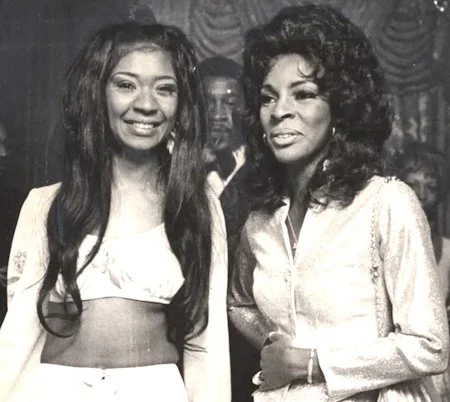
Martha Reeves and model Bev Smith at the 1971 ball (photo: Detroit Free Press)
The day after that edition of the ball, there was a celebrity brunch held for patrons who had donated $200 and $500. Immediately afterwards, Berry Gordy invited everyone present to a special preview of Lady Sings… at a nearby Detroit theatre.
In total, the 1972 Sterling Ball raised another $50,000 for the scholarship fund from the 700-plus guests.
Meanwhile, Brenda Boyce had started college at Wayne State in 1969 in the evening, while still working at Michigan Bell. “Delores Wilkerson, a friend of Mr. Gordy’s eldest brother, Fuller Gordy, came to Michigan Bell to train me on a new IBM machine. She told me about a position at Motown where they were trying to find someone to operate these new machines, which I had just started learning.” As a result, Wilkerson set up an interview for Boyce with Fuller Gordy, “who hired me on the spot to work for the famed record company in January of 1970. Goodbye, Michigan Bell. I was 18.”
In 1972, Boyce transferred with Motown to California, and did not see any of her fellow Michigan students until some years later. “One of them sang opera,” she recalls, “and I believe he was 15 when he graduated from high school and received the scholarship.” (This was likely to have been Melvin Barry White, the youngest student ever admitted to Wayne State. Despite his appetite for opera, he wanted to become a gynecologist.)
“Receiving this scholarship was special in so many ways,” concludes Boyce. “I wound up working for Fay Janet Hale, who was very close with the Gordy family, and always felt I was treated a little special because of that. Many times, Mr. Gordy would tell people that I received the scholarship.
“I finished college in Los Angeles at California State University. Pop Gordy came to my graduation, and the house party afterwards. I worked at Motown in the day and went to school at night. At different times, Pop would come by my office and ask, ‘Girl, you still in school?’ That also made me feel so honoured.”
Loucye Wakefield Gordy would have been pleased, too – not least by the fact that Brenda Boyce is still working for Mr. Gordy, many decades on, at his TGC Management. “Being in the company all these years,” she remarks, “I would say the foundation made a good investment in me.”
Mentoring notes: Fay Hale, pictured above with Brenda Boyce, was one of Motown’s backroom believers who seemed to do everything: sales, billing, collections, personnel, inventory management, processing. She joined in 1961, but knew Loucye Gordy Wakefield from before that, when both were in the Michigan & Indiana Army Reserves. By 1976, she was a Motown vice president. There’s a bit more detail in this 2021 blog post, including her relationship with singer/songwriter Andre Williams. And to Boyce? She was “my friend, my hero, my mentor.” Hale died in 2020, at age 88.
Music notes: the original, 12-track Motown album which honoured Loucye Gordy Wakefield, In Loving Memory, was released in August 1968. Soon after Motown’s acquisition by PolyGram in 1993, it was reissued on compact disc. Then in 2018, with the Hitsville U.S.A. catalogue under Universal Music’s ownership, the album was made digitally available as a 35-track edition – and this should be what you find on streaming services today. It includes variations of some of the original LP tracks – mixes in stereo, for example – as well as additional recordings by the likes of Diana Ross & the Supremes, Marvin Gaye, Kim Weston and the Spinners. Some of these were previously unissued. Most sessions were produced by Harvey Fuqua, and some by George Fowler, who had run Motown’s gospel label, Divinity, during its brief existence.