Motown VF – 1963: Finding a Voice
BY PAUL HUNTER
Motown VF did not begin with French-language cover versions.
Like foreign films dubbed into French cinema, its music had to be translated, not only linguistically, but industrially and culturally, before it could become part of French popular life. This article introduces what I term “Motown VF,” borrowing the familiar cinematic expression version française to describe the process through which American soul recordings were absorbed into the French popular music industry during the 1960s.
Motown VF describes a process rather than a single event. American recordings first passed through the French recording industry before being adapted by publishers and lyricists, localised by performers, arrangers and studio musicians, and finally becoming part of the repertoire of French popular music. The story begins in 1963, when Berry Gordy’s young Detroit company was still struggling to establish itself in a market whose structures, listening habits and commercial practices differed markedly from those of the United States.
Although Motown had secured distribution across much of western Europe by the early 1960s, France remained elusive. Tamla’s European agreement with London Records produced little impact there before it was terminated, leaving France a particularly difficult market for the music coming out of Hitsville U.S.A.
Access to France depended on inserting Motown into the tightly organised Paris entertainment industry, where a relatively small number of major companies and strong independents dominated recording, publishing and distribution. Chief among them was Pathé-Marconi, EMI’s influential French subsidiary, which worked through networks of publishers, studios and highly unionised musicians. Before Motown could become popular in France, it first had to pass through the institutions that would make it culturally intelligible.
Motown’s breakthrough came early in ’63, thanks to another giant of the French music industry, Eddie Barclay. Nicknamed “L’empereur du microsillon” (“The King of Microgroove”), his Barclay Records became a top music production company in France as vinyl records became available through the 1950s. Barclay possessed wide access to adaptation writers, publishers, Paris studios, distribution and promotional outlets. He had already enjoyed considerable success with French-language adaptations of American songs, even if they were derided by self-appointed purists who claimed, “you can't sing rock’n’roll in French.”
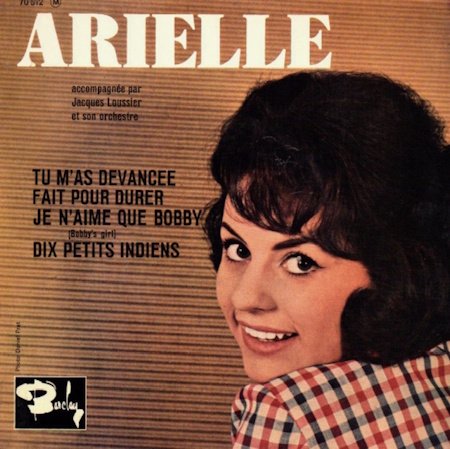
Motown came to Barclay’s attention in 1963, giving Gordy his first real opportunity to build confidence in the label among French audiences. Barclay offered more than distribution. It gave Motown access to the industrial framework through which it could begin its French localisation. Building upon multiple French-language adaptations of American songs by French chanson writers and recorded in Paris studios with local musicians, Barclay released an Extended Play (EP) by Arielle, led by “Tu M’as Devancée,” an adaptation of Mary Wells’ “You Beat Me To The Punch.”
WITHIN FRENCH YÉ-YÉ CULTURE
French-language adaptations did more than translate lyrics. They encouraged audiences to experience American popular music as part of their own musical culture. Adapted into French by Pierre Saka and Ken Lean, with an orchestral arrangement by Jacques Loussier, the song preserves the premise of Wells’ original while recasting it in idiomatic French.
Arielle’s performance transforms the deceived victim into a survivor of a toxic relationship readily recognisable to a French teenage female audience. The song found success on the French club circuit and was also released as a single in French-speaking Canada, where similar adaptation practices would later develop. The success of “Tu M’as Devancée” lay not in reproducing Wells’ original, but in making its emotional narrative sound as though it naturally belonged within French yé-yé culture.
To release a French version of an American song, French publishers typically obtained adaptation agreements from American rights holders through SACEM, the French collective rights management society. This brought Barclay into direct contact with Motown’s publisher, Jobete, whose permission was not automatic. Had the adaptation been judged to misrepresent the original song, approval could simply have been refused.
This first successful contact between Motown and Barclay paved the way for Motown’s initial distribution deal in France, with a two-year licence which allowed the distribution of Little Stevie Wonder on Barclay’s 707 and Riviera labels. The firm’s promotion of Wonder’s “Fingertips – Pt. 2” through the Europe 1 radio program Salut les Copains and a six-page article in the teenagers’ “go-to” magazine of the same name gave the youngster a late summer hit. This, in turn, led to an invitation to appear at Europe 1’s Musicorama concerts in December 1963 at the legendary Paris Olympia. (Berry Gordy’s first trip to Paris that year is detailed here.)
The licensing agreement illustrates that Motown VF depended upon cooperation between American copyright owners and French publishers. Cultural translation rested upon commercial negotiation. As Wonder’s stock was rising, along came EMI’s first agreement to distribute Motown across several European countries, including France.
Pathé-Marconi attributed French distribution to its international department, led by Jean-Jacques Timmel. Their initial enthusiasm for Motown was dampened upon discovering that distribution would not include Wonder. His output remained under licence to Barclay until late 1965. As Motown’s only French hitmaker at the time, his absence made Pathé-Marconi’s task of establishing the American label more difficult, as the latter lacked a known standard-bearer.
However, it was again Motown VF that put the label in the public eye, as renowned entertainer and ex-Barclay-label singer Henri Salvador’s new label, Salvador, took on a Miracles’ hit. October 19, 1963 saw the release of “Lam’di Lam” by Jackie Moulière. This was “Mickey’s Monkey” adapted into French by Georges Aber, himself a singer of American rock-blues adaptations, recently turned songwriter.
Moulière was accompanied by Christian Chevallier and his orchestra in the Studio Europa Sonor. His route from film to Salvador's label illustrates how Paris’s interconnected networks operated in practice. He met Salvador alongside Sylvie Vartan through their joint appearance in the 1962 film Un Clair de Lune à Maubeuge, and he signed with the label.
HAPPY, RHYTHMIC, SING-ALONG
“Lam’di Lam” was his third hit for Salvador, all of which were French adaptations of American hits, most notably “Un Beau Jour” – the Chiffons’ “One Fine Day.” The song gained immediate popularity after Salut les Copains named it Chouchou de la Semaine (“This Week’s Sweetheart”). This ranking ensured regular play over several months on Europe 1 radio and prominent coverage in Daniel Filipacchi’s Salut les Copains monthly magazine.
This, of itself, was sufficient to make the song a hit, given the radio station’s massive appeal and the magazine’s enormous teenage following. The publication had quickly achieved sales of a million a month, making it a major force in the booming teenage yé-yé market. With a jukebox-45 release, further play in clubs and cafés boosted the record’s popularity and performance rights earnings.
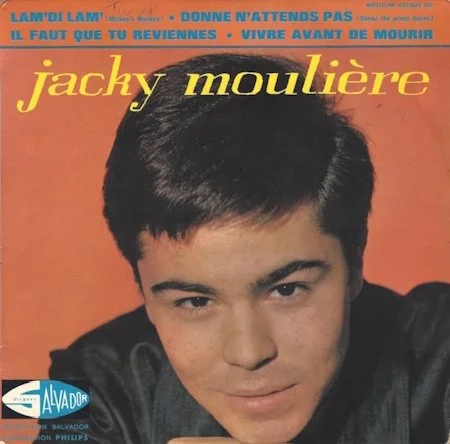
In addition, “Lam’di Lam” was the lead title on a Super-45, a four-track EP, and the track became a Top 30 hit from November 1963 through January 1964 in its own right, according to retrospective charts produced by Jukebox magazine and Infodisc.fr.
The happy, rhythmic, sing-along chorus found instant appeal among young record buyers and dancers. The lyrics relate to the apparent beneficial effects of singing “lam'di lam” rather than dancing to “Mickey's Monkey.” Still, the tone and large chorus make for a yé-yé offering that is, in many ways, similar to the Miracles’ original.
The song is an early example of how French adaptations worked. Translating the lyrics word-for-word wouldn’t connect with local youth culture and sensibilities. Worse still, the translated lyrics, with varying word lengths and syllables, would not scan or fit French rhyming patterns.
Equally important, the music was produced by French musicians accustomed to playing chanson-style orchestral backing based on strings rather than the drum-and-bass rhythmic beat of American music. The differences from the original render the song difficult for American R&B aficionados to accept, arguably explaining the disdain with which French-language adaptations were met at the time of their release.
Motown VF was therefore not simply a matter of translation, but of localisation. It preserved the appeal of an American hit while recasting it in forms that sounded natural to French performers and audiences.
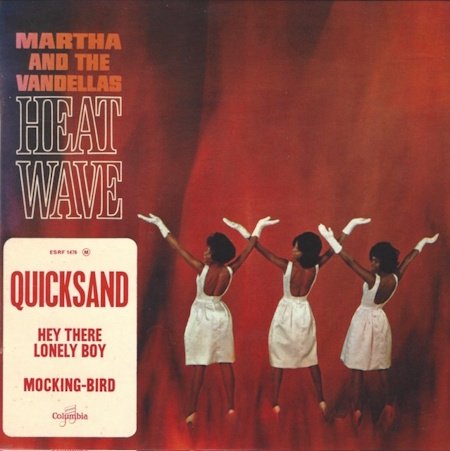
Pathé-Marconi burst onto the scene late in winter 1963 with their first original Motown releases. Two Super 45s and a Jukebox 45 presented Mary Wells, led by “What’s Easy for Two is Hard for One,” and Martha & the Vandellas with “Heat Wave,” all on the Columbia label. The EP was the primary record format in France at the time. Unlike the standard American or British two-track single, the four-track EP (or Super 45) acted as a showcase for an artist’s repertoire.
A laminated picture sleeve, photographs and liner notes made the record a desirable object of teenage fandom in its own right, while four tracks allowed different songs to find audiences through radio, jukeboxes, clubs and the music press. Deciding which recording could be regarded as the ‘hit’ is therefore problematic, since different tracks on the same disc often gained popularity for different reasons.
More than simply a record format, the Super 45 shaped the distinctive way French audiences discovered, collected and experienced popular music. It was within this uniquely French musical landscape that Motown VF found its first voice.
Paul Hunter is a researcher and collector specialising in the international history of American popular music, with a particular interest in Motown. His current Motown VF research examines how Motown recordings crossed linguistic, cultural and industrial boundaries to become part of French and Francophone popular culture during the 1960s.
SELECTED MOTOWN VF 1963 DISCOGRAPHY:
Arielle, “Tu M’as Devancée” (“You Beat Me To The Punch”)
EP: Barclay 70512 (France) 45: Barclay B-156 (Canada)
Jackie Mouliére, “Lam’di Lam” (“Mickey’s Monkey”)
EP: Salvador 432 993/45: Salvador B 373.218
Jacques Denjeanet son Orchestra, “Mickey’s Monkey” (instrumental)
EP: Polydor 27076 (France) 45: Polydor S 1165 (Netherlands)
Sophie José, “Lam’di Lam” (“Mickey’s Monkey”)
45: Franco-elite F-9331 (Canada)
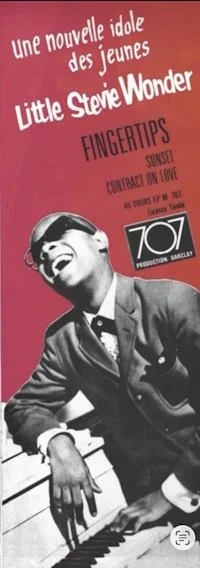
Little Stevie Wonder, “Fingertips 1re et 2e Partie”
EP: 707 label, 702
45: “Fingerstips” (sic) Part 1” 707 label, 603
Little Stevie Wonder, “Workout Stevie, Workout”
EP: 707 label, E.4501
45: 707 label, S.4501
Mary Wells, “What’s Easy For Two Is So Hard For One”
EP: Columbia, ESRF 1453
Martha & the Vandellas, “Heat Wave”
EP: Columbia ESRF 1476
45, “Quicksand”/“Heat Wave,” Columbia SCRF 725