A ‘Life’ at the Top
WHILE RETAILERS BATTLE IT OUT BELOW
On the day Stevie Wonder made U.S. chart history for the third time, he was visiting his former elementary school teacher in Detroit.
“He was such a lovely child,” Mrs. Constance Beneduci told a journalist that afternoon, while waiting for Stevie to show. “Always making up tunes and lyrics, singing songs. Such a pleasant person. A sweet child. Never rude or disorderly. I encouraged him to take up drums.”
Wonder was in town at the University of Detroit for a benefit dinner to raise funds for a blind students’ study centre. He and his long-ago teacher met in the library there, 13 years since their last encounter. “Mrs. Beneduci?” he said. “It’s you. Wow. How you doin’? Wow, it’s really you!”
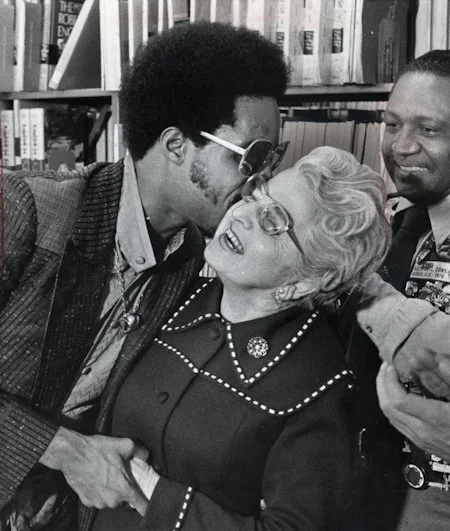
A kiss for his teacher (photo: Bob Scott, Detroit Free Press)
It was Saturday, October 16, 1976, and the Billboard top 200 albums chart of that date displayed the superstar’s arrival at Number One with Songs In The Key of Life. This was the first time that an American artist had debuted at the summit, just as Wonder in 1963 had been the first to score a simultaneous Number One single and album on the Billboard charts. (His “Fingertips – Pt. 2” was also the first “live” 45 to top the Hot 100.)
The record business – and, for the most part, music critics – was excited by Wonder’s latest accomplishment. “There are more hooks in the songs than there are at a fisherman’s convention,” declared the Detroit Free Press. “Trying not to hum some of the songs after hearing them is like consciously not thinking about a purple unicorn.”
“It’s a 21-song tour de force featuring a selection of musical moods ranging from the fury of the hurricane to the calmness of its eye,” observed the Chicago Tribune, invoking a different metaphor. It is “an epic pop work,” judged the Los Angeles Times, “one so rich in musical textures and social purpose that it emerges as even more ambitious and accomplished than either of the Motown artist’s last two releases.”
Admittedly, not everyone in the press concurred. “It’s not that the music is bad – Wonder is too good for that – it’s only that so much of it is mediocre. In fact, the good stuff would just about fill a single disc,” grumbled the New York Daily News. “It’s just that, for me,” muttered the San Francisco Chronicle’s reviewer, “Songs In The Key of Life, all one hour, 44 and a half minutes, doesn’t match the impact of three minutes of ‘Uptight (Everything’s Alright),’ ‘Signed, Sealed, Delivered I’m Yours,’ or even ‘Hey Harmonica Man.’ ”
Some critics had heard the album a few weeks earlier in Wonder’s company, at a preview party held at a Massachusetts farm-cum-recording studio, as recalled here. The man himself did little visible promotion after that, although he did grant Robert Hilburn of the Los Angeles Times an interview, which ran the day after the album arrived at the chart summit.
‘GET SOME OF THAT FEELING BACK’
“One of the great things about music is that it can bring people together,” Wonder told Hilburn. “That’s what was so exciting about the late 1960s. There was a feeling of such unity and celebration. So much was happening…Motown, Dylan, Hendrix, the Beatles, Sly. I hope we can get some of that feeling back before the ’70s are over.”
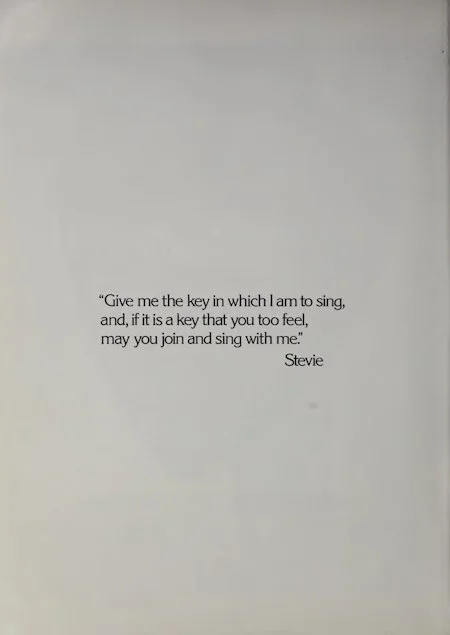
October ‘76: a trade press ad from the man himself
On a more transactional level, retailers of the day welcomed any album which became a cultural event, so impactful that even occasional visitors to record stores had to make an exception and buy it – and perhaps make another album purchase in the process.
“Almost everywhere the response to the album was immediate and overwhelming,” reported Record World. “Virtually all of the retailers surveyed last week said that sales were far heavier than even they had anticipated in preparing their initial orders.” Motown’s national sales manager, Miller London, told Cash Box that it had seven pressing plants working 24 hours a day for the past ten days to meet demand.
Not that Motown wasn’t prepared. Berry Gordy had brought former sales chief Barney Ales back into the company as executive VP in late 1975, confident that he would know how to set up any new Wonder release. And he did. “We pulled all [our distributors] from the east of the country into Chicago,” Ales once told me, “to show them the album, play some music and tell them what we thought their order should be.” To seal the deal, Ales took each distributor into a private suite in the hotel and put them on the phone with Gordy.
“Berry told them how great they were, how we appreciated the long-term support and so on. I remember that Harry Apostoleris from New York, for one, was so thrilled that he talked to Berry personally. After they got done talking, I said, ‘I think you’re entitled to buy another 25,000!”
Before that, Ales closed another deal: Wonder’s re-signing to Motown. His predecessor, Ewart Abner, had announced a renewal of the superstar’s contract in August 1975 – but it wasn’t actually signed then. Back in office, Ales negotiated the finer points with Wonder’s attorney, Johanan Vigoda. Terms were finally agreed, and pens applied to paper on April 1, 1976.
That year, still another date was important: September 30. This was the deadline for any recording’s eligibility for the 1976 Grammy awards – and so, by coincidence or design, Songs In The Key of Life was released on September 28. When the National Academy of Recording Arts & Sciences announced the ’76 nominations a few months later, the Wonder work earned seven: Album of the Year (which it went on to win), Best Pop Vocal Performance/Male (which it also won, for the entire album), Best Pop Instrumental Performance, Best R&B Vocal Performance/Male (another win, for “I Wish”), Best Inspirational Performance, Best Instrumental Composition, and Producer of the Year (Wonder’s fourth triumph).
UNDERCUTTING THE COMPETITION
At the same moment that Songs… opened at the top of America’s charts, it was causing a stir on the ground. The 2LP-plus-EP set had a suggested retail price of $13.98, but some of the nation’s record chains were selling it for under $8 – to the disadvantage of independent dealers. In California, a number of black-owned stores in Compton protested to Motown; such retailers typically paid $7.60 at their local one-stops (wholesalers) for the release and sold it to the public for around $11.
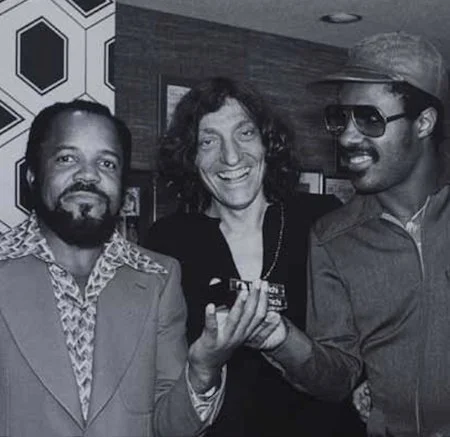
Johanan Vigoda seems pleased with the deal
Motown marketing VP Mike Lushka reminded trade press readers that it was “illegal” for record manufacturers to set retail prices, adding that “records must be sold at least six percent over the wholesale price, so naturally the larger stores are able to buy more and sell for less.” One of the steepest discounters in the state was Tower Records, which sold Songs In The Key of Life for $7.88.
Much of Motown’s initial promotion for the album was focused on radio. “I Wish” was not released as a single until late November, but stations in San Diego, Los Angeles and New York were among those playing the track as soon as the album was available. Another popular cut among programmers was “Isn’t She Lovely.” (Wonder was adamant that the latter should not come out as a single, but in the U.K., an enterprising songwriter, David Parton, covered it and reached the Top 5 in January of ’77.)
Songs In The Key of Life spent 13 weeks at Number One on the main Billboard album chart, from its October 16 debut to January 8, 1977, adding a 14th week later that month. The acts which had to be satisfied with a No. 2 peak during Wonder’s run were Boz Scaggs, Earth, Wind & Fire, Led Zeppelin and Rod Stewart. The album which finally dislodged it? The Eagles’ Hotel California.
In Britain, Songs… peaked at No. 2 for three weeks, denied the crown by a soul compilation album and a hits package by Bert Weedon, a 1960s guitar star. Wonder went on to occupy the U.K. Top 10 for a total of 19 weeks during a 54-week chart run. In Canada and the Netherlands, the album also reached Number One.
At home, Songs In The Key of Life occupied the Billboard Top LPs & Tapes chart for 80 weeks from that October 16, 1976 debut. It was diamond-certified for ten million sales by the Recording Industry Association of America in 2005 – when it was also selected for addition to the Library of Congress’ National Recording Registry, honouring recordings which are “culturally, historically or aesthetically important, and/or inform or reflect life in the United States.”
Three years earlier, Songs… was inducted into the Grammy Hall of Fame, and when Rolling Stone in 2023 updated its list of the 500 “greatest albums of all time,” Stevie Wonder’s masterwork was ranked at No. 4.
Constance Beneduci would have been proud.
West Grand Blog is taking a short break [Not another one! — Ed.]. See you on the other side, with luck.