Down on the Farm
THE LONG VIEW OF A MASSACHUSETTS PARTY
Any day now, the spotlight is certain to shine once more on Songs In The Key of Life, and many words will be written about it. But few, if any, about the original listening party for the album, which was held on an early 20th century Massachusetts farm, amid horses, ducks and cows, including a black calf called Stevie.
But, hey, that’s why you read West Grand Blog, right?
The reason for the renewed attention on Songs… will be its 50th anniversary next month. What’s widely considered to be Stevie Wonder’s finest work was also his most successful, with 14 weeks on top of the Billboard charts and, later, a diamond award from the Recording Industry Association of America for certified sales of ten million copies.
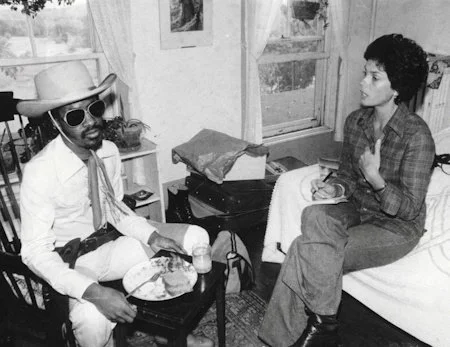
Songs in the key of lunch? Maureen Orth interviews Stevie
Songs In The Key of Life was originally released by Motown on September 28, 1976 as two LPs and an EP. A week earlier, the preview event – at Long View Farm in North Brookfield, 77 miles west of Boston – expanded on what had been done in New York for Wonder’s Innervisions in 1973. On that occasion, several dozen music journalists were invited, herded together, blindfolded, bused around Manhattan and then taken to a midtown recording studio to hear the album. It was suggested that sound takes on greater meaning when vision is denied.
Gil Markle, a former philosophy teacher, bought Long View in ’73, originally intending it as a home. However, a fascination with electronic equipment led him to renovate the house and add a recording studio. (Markle’s mother had sung with the Tommy Dorsey band.) The rural setting proved popular with local musicians, and then beyond.
The idea for both of Wonder’s New York and Massachusetts media events is thought to have originated with Wartoke Concern, Inc., which took on his publicity account in 1972. The farm setting was rurally attractive and sufficiently accessible from elsewhere. “My recollection is that we all met at a hotel in New York,” said Carl Arrington, music editor for the Detroit Free Press at the time, “and then went by bus to an airport – I forget which one – and took a short flight to Massachusetts.” From there, orange school buses transported the guests to Long View. It was September 21, 1976.
“I had no prior expectations of the listening party,” Arrington told me. “I’d never been to such an event before, after only working at the Free Press for a few months.” The vibe on-site, he added, was “cheery and fun. I knew no one else there, but got to see several people whose bylines I was following.”
Among them was Newsweek’s Maureen Orth. “We arrived to find two bars stocked with champagne, a feast of home-cooked food, including a 60-pound side of beef,” she later recalled. “The music was piped through the ranch house so people could lie in front of the fire in the living room, sit by the pot-bellied stove in the kitchen, or flop on the beds and listen to the new album.”
A BREAK FOR LUNCH
More importantly, they were in the company of Wonder himself. He arrived that same day from Los Angeles, and greeted the gathering in a beige-coloured cowboy suit, with a special gun-belt which held copies of the Songs… album sleeve, complete with a printed slogan, “Number One With A Bullet.” (Three weeks later, the record debuted at Number One in Billboard – with a bullet.)
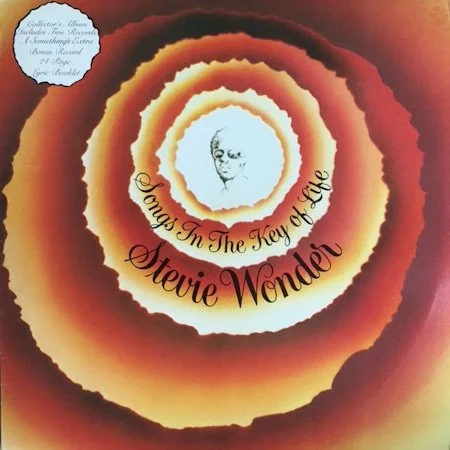
‘A positive idea of tomorrow’
But Wonder’s outfit “was not the outlaw grubbies you might expect to find on the range,” Arrington remembered, “but the sort of flashy duds you see in promotion pamphlets for dude ranches.” The star also wore orange dark glasses, leather gloves and boots, and under one arm were two boxes of tapes, containing the first of the album’s two LPs, which were then played for the assembled guests in the farm’s studio, while he sat on a red carpet in front of the mixing console.
“The album is meant to relate to the experiences of people,” explained Wonder, “many people, my people, everyone. To me, it’s as significant as my life itself. It involves taking a look at the problems we experience in life, and giving them the kind of constructive criticism and assistance that will make life better.
“It’s for those who believe in a positive idea of tomorrow. It deals with many things: love, because we relate to it because we want it to last forever. It’s the kind of album we hope everyone will enjoy because we gave a good deal to it. But, all in all, it doesn’t matter what people think, provided you know you gave your best. I hope that people will take some time to listen to it before they come to any definite conclusions.”
After the first LP was previewed, there was a break for lunch. “This was not to be a couple of Spam sandwiches and a can of pop,” Carl Arrington wrote in his Detroit Free Press report. The menu included seafood chowder, Delmonico potatoes, stuffed tomatoes, New England-style zucchini, roast beef, steamed swordfish, salads, pudding and ice cream. The feast doesn’t immediately come to mind for David Nathan, then the U.S. correspondent for Blues & Soul magazine, but he does recall getting acquainted with members of Wonder’s entourage, most notably Gary Byrd (later to have a U.K. hit with “The Crown,” produced by Wonder).
Still, the journalists were there to work, with some – such as Maureen Orth – securing one-on-one interviews. “I’m not a minister,” Wonder told her, “but I get the feeling that when I’m singing, I’m just the vehicle.”
The second Songs… LP was played to the assembly after lunch, followed by options of touring the farm by helicopter or haywagon, going fishing or playing pool. Then the star undertook his own tour of Long View, sparking a flurry of activity from the photographers. “I was surprised how aggressive they were toward one another,” said Arrington, “jostling to get the shot which might make them rich.” With Wonder was Ira Tucker, part of his Black Bull team. Also on set, as it were: Stevie’s then-wife, Yolanda, and their two-year-old daughter, Aisha, star of “Isn’t She Lovely.”
ROAST BEEF AND MASHED POTATOES
Long View Farm’s recording facilities were hardly mentioned in the subsequent coverage of the event, but they were one of the reasons why Gil Markle’s property was known in the music business – that, and the fact that he served as engineer on a number of projects done there. (Wonder’s work was not among them: he recorded the album in California and New York.)
Someone familiar with Long View at the time is Charles Kipps, who co-produced (with Van McCoy) most of Gladys Knight & the Pips’ 1977 album, Still Together, there. “Calling themselves Stuff, the group of studio musicians that Van and I always booked for our sessions was recording their first album at Long View Farm,” he recalled for me recently.
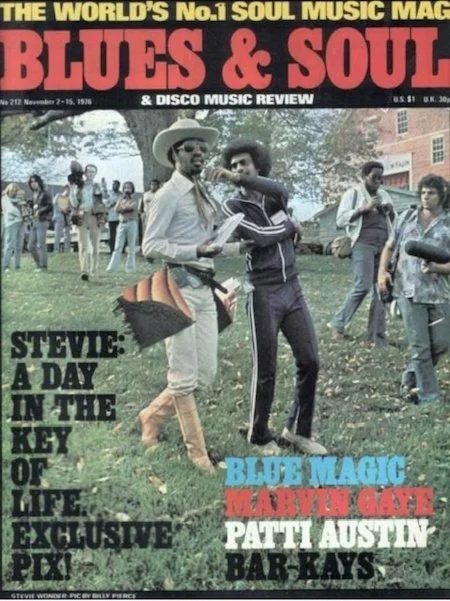
David Nathan gets the B&S cover story (and that’s Ira Tucker with Stevie)
“Since we were ready to record tracks for Still Together, we had to trek to the Massachusetts countryside in order to have our regular crew. At least Gordon Edwards, leader of Stuff, sent a Greyhound-size bus to transport Van and I to Long View. Once there, I saw six jaded, New York musicians sitting around a rough-hewn wooden table while earth mothers in long flowered dresses served roast beef and mashed potatoes. It wasn’t exactly a Norman Rockwell painting.”
Kipps also discovered that Markle had previously been a philosophy professor at a nearby university. “Actually,” he says, “that was the perfect person to have set up a recording studio in the middle of nowhere. In some ways, he seemed like a benevolent cult leader with a gaggle of female flower children among his flock.”
It may be a stretch to suggest that Stevie Wonder, too, is a benevolent cult leader, although the amount of media attention soon to be his again will probably outshine any other superstar musician who hasn’t made an album in 21 years. Perhaps he should rebook Long View for the anniversary, and invite journalists young and old. He could bring Aisha along, too, although she might find it hard to replicate the sounds she originally made for the album.
And now, by way of conclusion, here’s a brief snapshot of how Songs In The Key of Life was reviewed upon release. With one exception, it’s not known how many of these reviewers made it to Long View Farm a half-century ago.
“Stevie Wonder’s long-awaited album is – by pop music standards – a monumental work; one that mixes the classic, accessible charm of pop music with a strong sense of moral and philosophical responsibility. Not since John Lennon’s brilliant first solo album in 1970, in fact, has a major pop figure used his music so effectively or so forcefully as a platform for relaying his own social concerns.” Robert Hilburn, Los Angeles Times
“The musicianship throughout is first-class, as is the production. After two years of preparation, you don’t slip up on your basic training. Meanwhile, if Wonder contrives nothing startlingly original here, the catchment areas for his music have expanded enormously, and his stylistic range pays full dividends.” Bob Woffinden, New Musical Express
“Ultimately, the work is most successful as an autobiographical statement. His love songs seem to chronicle his relationships with an accent on his current love, Yolanda Simmons. These range from simple serenades to lusty tributes. They are highlighted by the best cut on the entire set, called ‘As,’ which combines clever lyrics, fine rhythms and good pacing.” Carl Arrington, Detroit Free Press
“The material itself varies so widely that even after weeks of listening it’s difficult to get a critical fix. This is one of the album’s pleasures — I found myself constantly discovering and falling in love with new cuts I’d somehow overlooked. The album offers something fresh at each listening, something right for every mood. But it’s also one of the record’s annoyances — it has no focus or coherence. The eclecticism is rich and welcome, but the overall effect is haphazard, turning what might have been a stunning, exotic feast into a hastily organised potluck supper.” Vince Aletti, Rolling Stone
“What makes Mr. Wonder’s new record into a marvel is the way he sweeps all his tricks into a vision that is completely personal. One emerges from this album not only entertained and moved, but with the sense that one knows Mr. Wonder better. This may indeed be a self-indulgent album, but that’s all right if the self indulged is worth it.” John Rockwell, New York Times
West Grand Blog is taking a short break. See you on the other side, with luck.
Music notes: the breadth of artists who have recorded songs from …The Key of Life is noteworthy, ranging from Patti Smith to George Michael, from Kathy Sledge to the East St. Louis Gospelettes. Here are some in this Spotify playlist, tracked to the original album’s sequence, and concluding with Coolio’s hip hop (and chart-topping) remake of “Pastime Paradise.”
Anniversary notes: thanks to Carl Arrington, Charles Kipps, Zeth Lundy, David Nathan, Harry Weinger and Susan Whitall. Sadly, Gil Markle is no longer with us. Newsweek’s Maureen Orth, quoted above, is among those who offered related reflections in The Wonder of Stevie, Audible’s 2024 podcast series. A selection of images from that sunny September day of ‘76 can be found on the Instagram account of photographer Richard Aaron.