The Passion and Conviction of ‘Ab’
FROM VEEJAY TO MOTOWN, AND TO STEVIE’S SIDE
He was the second president of Motown Records. He was a central figure in the maturing (and political) career of Stevie Wonder. He was closely involved in the multi-million-dollar sale of Jobete Music. And before all of that, he was a driving force at one of the few successful black-owned record companies of the 20th century.
So it’s quite remarkable that, to date, there has been no biography of Ewart Gladstone Abner III.
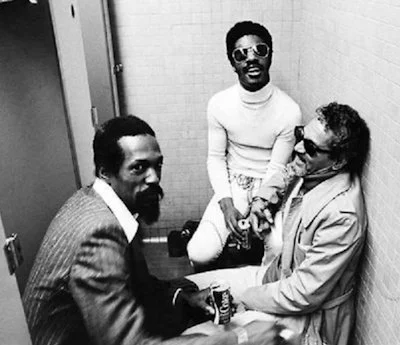
Ewart Abner (right) with Stevie Wonder and Eddie Kendricks
Not that there hasn’t been plenty written about him over the years. The son of a minister, “Ab” was born and raised in Chicago, qualified as an accountant, became a productive player in the local music scene via Chance Records during the first half of the 1950s, and then did the same nationally when he worked for Vivian and Jimmy Bracken’s VeeJay Records in the second half and beyond.
The blues and soul hitmakers at VeeJay included the El Dorados, the Spaniels, Jimmy Reed, the Dells, John Lee Hooker, the Impressions, Jerry Butler, Gene Chandler and Betty Everett. Plus – with three consecutive Number Ones on the pop charts – the Four Seasons. Abner was fired as president in 1963, but returned a couple of years later amid the label’s continuing financial difficulties. It went out of business in 1966.
By his recollection, Berry Gordy first encountered the VeeJay executive circa 1960 at a meeting of the National Association of Radio Announcers, a trade organisation for black disc jockeys. With a speech about the power such DJs had on their stations and in their communities, “Abner had electrified the NARA audience with passion, conviction and guts,” the Motown founder wrote in To Be Loved. Later, he described him as a “person of high integrity, rich vocabulary and a strong sense of black pride.”
After VeeJay’s collapse, Abner paid a visit to Detroit. He had written to Gordy, who was interested in his experience, and apparently shared with him a wish to delegate responsibility at Motown – or, as Abner wrote in a February ’67 letter, “your personal desire to be relieved of the many time-consuming functions and details which, of themselves, should not require your constant, personal presence or attention.” He added, “The harmonious and secure relationships which you have carefully built and fostered among and between your artists, staff, employees and yourself must be preserved, and certainly not endangered by the addition of new personnel.”
Abner was preoccupied that year by two other matters: one, an Internal Revenue Service prosecution of a former VeeJay financial officer for bribery connected to the firm’s tax affairs, and two, the status of Exodus Records, which Abner had recently formed in Chicago and which had leased repertoire from VeeJay. During the trial, he was accused of stealing $100,000 from the Brackens’ business, which he denied. “Did you borrow money?” asked the label’s defence lawyer. “Yes,” Abner responded, but not more than $12,000. He confessed to gambling in Las Vegas with some of it. He also noted that he owned a third of VeeJay.

A young, suave Ab at VeeJay
(Years later, one of Gordy’s most senior executives, Barney Ales, told me that when Abner was hired at Motown in 1967, he was contacted by associates in Las Vegas to find out “how much money [Abner] still owed.” Ales added, “I had to talk to him: ‘Look, you can’t keep going to Vegas anymore.’ ”)
As for Exodus, it’s not clear what the resolution was. At one point, he suggested that Gordy could buy into it, but given the acuity and wisdom of the Motown chief’s financial advisors, the Noveck brothers, this seems an unlikely outcome.
Nonetheless, Abner was hired at Motown in August 1967, joining its talent management team and working with senior executives Esther Gordy Edwards and Harvey Fuqua. Among his early challenges was handling the dismissal of David Ruffin from the Temptations, which the executive attributed to the singer’s tendency to act selfishly. He explained, “As a member of a group such as the Temptations, each of the men has to subordinate his own individual desires and actions so that the group, as a collective entity, can be developed to its maximum potential. David, whom we consider a great artist, was nonetheless unable to subscribe to this team effort.”
In August ’68, Abner was promoted to vice president of the International Management Company (IMC), Motown’s corporate successor to what had previously been International Talent Management, Inc. (ITMI). Judging by the Ruffin remarks, his way with words came in handy, as did his many years dealing with artists at VeeJay.
OUTSPOKEN AT MOTOWN
Also, his strong sense of black pride was appropriate when, in 1970, Berry Gordy assigned to Abner, publicity director Junius Griffin and attorney George Schiffer the responsibility for creating and operating a new, spoken-word imprint, Black Forum. “The three,” Gordy subsequently declared, “were the most outspoken at Motown when it came to social causes.” While there, Abner co-produced Free Huey!, the album by black nationalist Stokely Carmichael, and the label’s second release, in October ’70.
The next significant advance in his Motown career came when the company moved west in 1972. That summer, Abner was appointed VP of marketing, and then – after the relocation to California was complete, and executive VP/general manager Barney Ales had left – he became president of Motown Records.
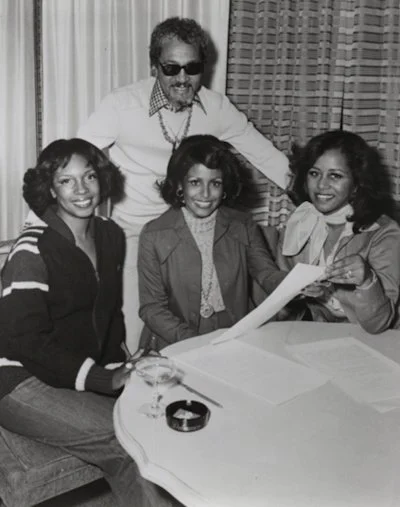
Abner with the Supremes, 1974
With Gordy invested in movie-making, the responsibility for A&R lay primarily with Suzanne de Passe, and the artist roster seemed to be diversifying. In a rare 1973 trade press interview, Abner said, “Hopefully, Motown will always retain that part of its image that deals with a ‘Motown sound’ – the guts, the soul, you know. We’ll have that, that’s part of us, that’s what we are. But again, a year from today, I think you won’t be able to know what is typically a Motown artist or not.”
Indeed, by then, several typical Motown artists were not. Both Gladys Knight & the Pips and the Four Tops had gone to other labels, and the Jackson 5 were unhappy because of faltering record sales. In his autobiography, the Tops’ Duke Fakir claimed that during contract renewal negotiations, Abner had said that “we don’t really need you guys anymore.”
In her memoir, Knight remembered that after he was appointed Motown president, Abner gave the group a $2,000 check and a gold award for “Every Beat Of My Heart,” released by VeeJay in 1961, when he was there. “It was a nice gesture, but we knew he probably owed us a lot more than $2,000 and a wall plaque.”
As for the Jacksons, Gerald Posner’s Motown noted that as far as Joe Jackson was concerned, the reason for sliding sales was the company’s failure to adequately promote his sons. “Ewart Abner would hear none of it. He made a quick enemy of Joe by suggesting that maybe the group was to blame for its falloff and that its success might have run its course.”
By contrast, Abner’s relationship with Stevie Wonder was strong – helped by the support and attention he gave at the time of the musician’s near-fatal road accident in August 1973. Gordy sent his president down to the hospital near Durham, North Carolina, to ensure the right care was provided for Wonder, and to stay by his side until recovery. The incident earned Abner new respect from the star as his creativity was reaching its peak, and as his business needs increased. And yet…
A TAP DANCER
With motion pictures consuming most of Gordy’s time, it may have been unrealistic to expect Abner to deliver the imagination and control that Motown needed in the mid ’70s, when it was complex and growing – and when major-label competitors were pouring more resources into black music than ever before.
There were also critics other than artists. “He was a heavy drinker,” claimed Jay Lasker, who had worked at VeeJay in the early 1960s. “He kept weird office hours. He paid little attention to detail and planning.” Another executive acquainted with Abner was Stewart Levine, co-owner of Motown-distributed Chisa Records. “He was a tap dancer, man. Very slick, very entertaining, but not to be trusted,” Levine told me in 2013. “He had a lot of charisma, but it was showbusiness. It was pure shuck and jive.”
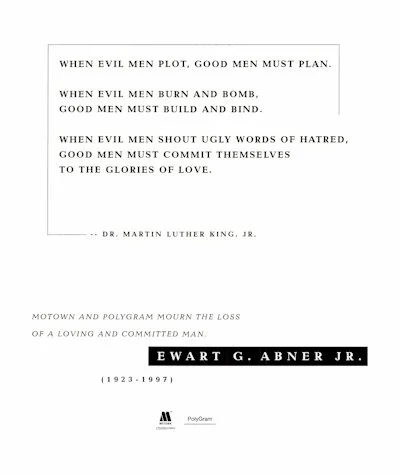
A tribute upon Abner’s death in 1997, at age 74
Not everyone agreed. John Sippel, a seasoned Billboard editor who had worked at record companies before joining the trade journal, said, “Abner was a terrific guy. He was perhaps as sharp a black person from a business standpoint as anybody I ever met. He was an accountant, after all.”
By the last half of 1975, however, Gordy was no longer happy with Abner’s performance; he paid him off and brought back Barney Ales to run the record company. At which point, the dismissed president formally became one of Stevie Wonder’s most trusted aides, particularly as the musician ventured into the political arena – campaigning against apartheid in South Africa, for example, and striving to have Rev. Martin Luther King’s birthday made into a federal holiday. Also, in 1978, Abner co-founded the Black Music Association and served as its executive VP.
“Stevie doesn’t have to leave music to run his businesses,” Abner told Cash Box in 1982, just after Wonder had re-signed to Motown. “He has a very unique timetable – it’s never day or night, it’s always now. I may get a call at 3:00 a.m. to discuss his last financial statement or to get on a plane to somewhere because there’s something he’s interested in doing.”
In later years, Abner became close again with Berry Gordy, serving as executive VP of Jobete Music. At the memorial service following Abner’s death on December 27, 1997, his son, Tony, said his father was most proud of his participation in the sale of Jobete to EMI Music Publishing, which ultimately earned Gordy more than $300 million.
As a further measure of the regard in which Ab was held at Motown, both Stevie Wonder and Smokey Robinson spoke at the service. The latter remembered how the executive used to talk with his hands. “I would sometimes make up questions, simply so I had an excuse to walk into his office and get a response.”
And Gordy recalled how, when the two music men would together attend important industry conferences, the rooms would be filled with people in business suits and ties – then Abner would walk in, wearing a T-shirt, slacks, sandals and an earring. “And everything just fell into place.”
Safety notes: An unexplained moment in Ewart Abner’s career occurred only months after joining Berry Gordy’s business. On October 13, 1967, he submitted in writing his resignation, and apologised to his benefactor for “the series of events that occurred Wednesday, October 11, which jeopardised the security and safety of Motown Record Corporation, its employees and your person.” This was, he added, “the direct result of my personal problems.” In the absence of any other information, one can only speculate. Did individuals to whom he may have owed gambling debts drop by Hitsville and cause trouble? A “series of events”? The answer may be lost to time, but if anyone knows more…
West Grand Blog is taking a short break. See you on the other side, with luck.