Still Smokin’
THE ROBINSON LEGACY IS SHOWCASED IN A NEW ALBUM
Over the past six decades, the songs showcased in this compilation have been recorded by more than 1,000 different singers and musicians. To its credit, Shop Around: The Smokey Robinson Songbook contains a number of the more interesting versions.
The 24-track CD is issued on April 24 by Britain’s Ace Records, which is respected among Motown followers worldwide for mining the unusual, the deserving and the obscure from the Hitsville U.S.A. vaults. Three of Smokey Robinson’s most revered songs are present: “The Tears Of A Clown,” “You’ve Really Got A Hold On Me,” and “I’ll Try Something New.” In this instance, their interpreters are the Beat (known in the U.S. as the English Beat), Sonny & Cher and Kiki Dee, respectively.
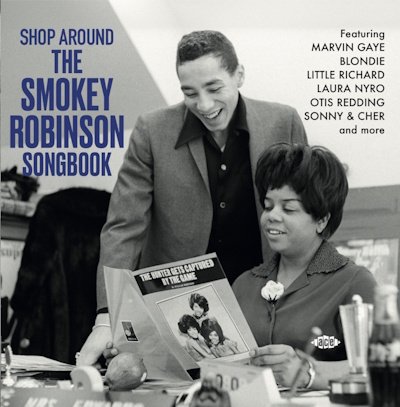
Esther inspects his work
Other artists on Shop Around who are not usually associated with his catalogue include Blondie (“The Hunter Gets Captured By The Game”), Ella Fitzgerald (“Get Ready”), Little Richard (“The Way You Do The Things You Do”) and Laura Nyro (“Ooh Baby Baby”).
Also, there are some of Robinson’s lesser-known works, such as “Oh I Apologise,” first heard as the flipside of Barrett Strong’s “Money (That’s What I Want),” and offered on this Ace set by Lonnie Mack; “The Further You Look, The Less You See,” originally cut by the Temptations and offered here by reggae star John Holt; and “Who You Gonna Run To,” a track from the Temps’ debut album in 1964, and interpreted by another reggae act, the Shades, fronted by Bruce Ruffin.
Shop Around: The Smokey Robinson Songbook also benefits from detailed liners by its compiler, Tony Rounce. Of the Kiki Dee track from 1969, for example, he notes that it was intended for her second Motown LP – in the event, never-released – and snuck out five years later on a Dee collection from EMI Records’ U.K. budget label, Sounds Superb.
In the case of “Don’t Look Back,” featured on the Ace album in a take by Bettye Swann, Rounce observes that it was also recorded no less than three times by Peter Tosh of the Wailers, including a duet with Mick Jagger which became a minor hit in the U.S. and the U.K. in 1978. The original by the Temptations was an R&B Top 20 success in late ’65.
Another of Robinson’s jewels, “Ooo Baby Baby,” makes an appearance not – as might be expected – by way of Linda Ronstadt’s Top 10 pop hit of 1978, but via a 1995 recording by the late Laura Nyro. The latter’s version first appeared on her 2001 album, Angel In The Dark.
Seven of the two-dozen tracks on Shop Around are by British acts, the Beat and Dee included. The others are Helen Shapiro (“My Guy”), Billy Bragg (“The Tracks Of My Tears”), Elvis Costello & the Attractions (“From Head To Toe”), the Searchers (“I’ll Be Doggone”) and Johnny Kidd & the Pirates (“Shop Around”). Rounce has form in this regard: he compiled and annotated an earlier compilation – also from Ace – called On The Detroit Beat: Motor City Soul, UK Style 1963-67.
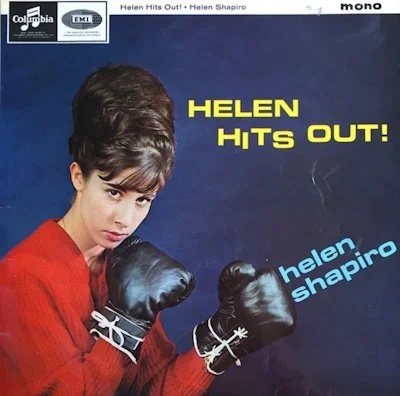
Punching above her weight?
That 2019 CD included tracks by Dusty Springfield, the Hollies, Georgie Fame, Billy J. Kramer with the Dakotas, the Small Faces, John Leyton, the Birds and Cilla Black, among others. Helen Shapiro is the only act who appears on both collections, and Rounce is evidently a fan, calling her “one of the best singers the U.K. has ever produced.” He points out that “My Guy” was among three Motown covers on 1964’s Helen Hits Out! (her second album), the others being “Shop Around” and “Please Mr. Postman.” On The Detroit Beat included another of Shapiro’s Motown remakes, “You’re My Remedy.”
The influence of Hitsville on the British “beat boom” of the early to mid-1960s was also the point of a 2000 compilation from Sequel Records, entitled Just Walk In My Shoes: The Songs of The Motor City. Again, Smokey’s work was featured prominently, including “You Beat Me To The Punch” (Tony Jackson & the Vibrations), “I’ll Be Doggone” (the Searchers, as also featured in the new Ace release), “It’s Growing” (Jimmy James & the Vagabonds), “My Girl” (Carl Wayne) and “As Long As I Know He’s Mine” (Julie Grant). Perhaps it’s no surprise that the annotator and co-compiler of that CD was Mick Patrick, who subsequently joined Ace Records and became responsible for many of its retrospective Motown packages.
In conclusion, then, here’s a rundown of the most popular Motown songs (not only those written by Smokey) as recorded by British artists since the early 1960s, and released as singles. They are ranked by their U.K. chart peak. The year of that peak is shown, and ties are broken by the number of weeks at Number One, or weeks on the chart. For any of these versions which also reached the Billboard Hot 100, that’s noted, too. And if you see any obvious omissions, please advise.
#1 “Dancing In The Street,” David Bowie & Mick Jagger, 1985 (#7 U.S.)
#1 “Do You Love Me,” Brian Poole & the Tremeloes, 1963
#1 “You Can’t Hurry Love,” Phil Collins, 1983 (#10 U.S.)
#2 “You Keep Me Hangin’ On,” Kim Wilde, 1986 (#1 U.S.)
#4 “I Want You Back,” Cleopatra, 1998
#4 “Isn’t She Lovely,” David Parton, 1977 (#105 U.S.)
#4 “This Old Heart Of Mine (Is Weak For You),” Rod Stewart, 1975 (#83 U.S.)
#5 “He Was Really Sayin’ Somethin’,” Bananarama with Fun Boy Three, 1982 (#108 U.S.)
#5 “Money (That’s What I Want),” The Flying Lizards, 1979 (#50 U.S.)
#5 “It Takes Two,” Rod Stewart & Tina Turner, 1990
#6 “The Tears Of A Clown,” The Beat, 1980
#9 “I Second That Emotion,” Japan, 1982
#13 “What Becomes Of The Brokenhearted,” Dave Stewart with Colin Blunstone, 1981
#14 “Money (That’s What I Want),” Bern Elliot & the Fenmen, 1963
#14 “Maybe Tomorrow,” UB40, 1987
#15 “Nathan Jones,” Bananarama, 1988
#16 “Loving You Is Sweeter Than Ever,” Nick Kamen, 1987
#16 “The Tracks Of My Tears,” Go West, 1993
#24 “You Need Love Like I Do (Don’t You),” Tom Jones and Heather Small, 2000
#25 “You Got What It Takes,” Johnny Kidd & the Pirates, 1960
#26 “Going To A Go-Go,” The Rolling Stones, 1982 (#25 U.S.)
#28 “You Got What It Takes,” The Dave Clark Five, 1967 (#7 U.S.)
#30 “Do You Love Me,” The Dave Clark Five, 1963 (#11 U.S.)
#32 “My Girl,” Rod Stewart, 1981
#38 “Bye Bye Baby,” Tony Jackson & the Vibrations, 1964
#41 “Every Little Bit Hurts,” The Spencer Davis Group, 1965
#45 “Leaving Here,” The Birds, 1965
#49 “The Way You Do The Things You Do,” UB40, 1991 (#6 U.S.)
#51 “This Old Heart Of Mine (Is Weak For You),” Rod Stewart with Ronald Isley, 1989 (#10 U.S.)
#60 ”Typical Girls/Heard It Through The Grapevine,” The Slits, 1979
#60 “The Tracks Of My Tears,” Colin Blunstone, 1982
Cover notes: as is evident above, Rod Stewart makes the most appearances – four – including with two different versions of “This Old Heart Of Mine (Is Weak For You).” His affection for the music produced in Studio A was likewise apparent with 1991’s “The Motown Song,” when he was accompanied by the Temptations. It reached No. 10 on both the U.K. and U.S. charts. And on the subject of British rock stars, the chart-topping popularity of Mick Jagger and David Bowie’s “Dancing In The Street” was arguably more the result of the record’s virtuous role in raising money for the Live Aid charity in 1985 than anything else.