A Rhythm King, R.I.P.
JAMES GADSON, SCHOOLED AT MOTOWN
As usual, Hal Davis cut to the chase. “He was the bad drummer on that,” the Motown producer declared. “Nobody can play that foot like him.”
The track was for Diana Ross’ “Love Hangover,” and the session took place at the Paramount studios in Los Angeles during the closing weeks of 1975. “I went in at two o’clock in the morning,” Davis continued. “I bought everyone a shot of Remy Martin. We got Joe Sample on the keyboards, who gave me a fight. He didn’t like the idea that it was a ballad. See, [Motown] didn’t want to uptempo it. I had to fight for that. In those days…”
And the drummer who uptempo’ed it? None other than James Gadson, one of the most respected and prolific session musicians of the 1970s and beyond, who died this past April 2 at the age of 86. The next day marked exactly 50 years since “Love Hangover” debuted on the Billboard Hot 100, driven by Gadson’s rhythmic rocket-fuel, and en route to the summit.
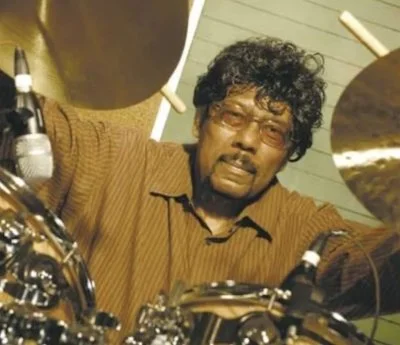
James Gadson, expressing himself (photo: Alex Solca)
Not that it was the drummer’s only Motown chart-topper in ’76. “Paramount was my lucky studio,” Davis recalled for me, once upon a time. “I cut ‘Don’t Leave Me This Way’ the following week, with the same guys.”
One of those same guys was Art Wright, whose propulsive lead guitar was a distinctive component of both “Love Hangover” and “Don’t Leave Me This Way.” He also arranged the Thelma Houston track. “James Gadson had a good feel for things,” said Wright, “and tempos that were just right. He was an excellent timekeeper with good intuition. I’d write the part out, and he’d read it and say, ‘Can I take any liberties?’ Sometimes, if there were no liberties to be taken, then I’d specify that.”
In an interview posted two years ago on YouTube, Gadson himself recalled his Motown days. “That was probably the school for me. Sometimes I’d be over there for three sessions, and our producers required that you would be able to play three songs. You were reading. The producers at that time, they wrote out everything.” He added, “You had to be on it. If you wasn’t on it, they would call you out and get somebody else. Made you ready.”
The Gadson obituaries of recent days, such as this one, have identified the Jackson 5’s “Dancing Machine” as the first Motown track on which he played. By most accounts, he had moved to Los Angeles during the mid-1960s; there, he joined the Watts 103rd Street Rhythm Band, who scored three Top 20 pop hits at the turn of the decade, including “Do Your Thing” and “Express Yourself.” In 1971, he signed with Supreme Records, where he produced Viola Wills, then hooked up with Bill Withers as the latter began breaking into the big time.
‘HEY, DO THAT AGAIN’
Subsequently, Gadson began working on Motown sessions, the result of a recommendation by arranger James Carmichael and contractor Ben Barrett. Carmichael was working with the Jackson 5; hence, Gadson playing on “Dancing Machine.” The musician later told Modern Drummer’s Bill Amendola, “We were out there creating, and I put that 8th-note hop in, and they said, ‘Hey, do that again.’ They liked what I was doing, and they said, ‘Let’s keep him because he has good time.’ And then the song became a hit.” Indeed it did, reaching Number One in Cash Box and No. 2 in Billboard, albeit the brothers’ last major hit as a Motown act.
“After ‘Dancing Machine,’ we almost exclusively used James,” Art Wright told me in 1991. “At that time, we were still recording at the Sound Factory. The Motown studios had not opened up.”
Despite the importance of What’s Going On in terms of identifying Motown musicians on album covers, the company did not include those names on all of its mid ’70s output, even though the arrangers were often cited. A case in point: the Jackson 5’s Dancing Machine long-player.
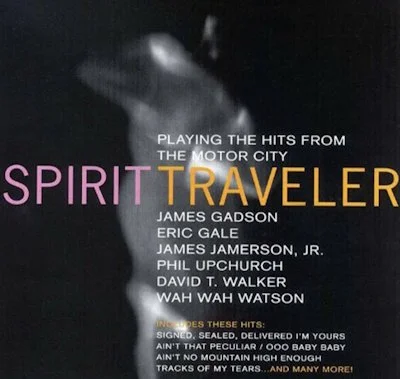
A super session, recorded for Japan’s JVC in ‘93
Gradually, that changed. Credit for Gadson and his fellow session players (including other drummers) began showing up – for instance, on the Temptations’ 1990 and A Song For You, Eddie Kendricks’ Boogie Down and The Hit Man, the Undisputed Truth’s Down To Earth and Higher Than High, the Miracles’ City Of Angels and Yvonne Fair’s The Bitch Is Black.
The most celebrated Motown project on which Gadson played – he was its only drummer – was Marvin Gaye’s I Want You in 1976. Coincidentally or not, the contractor for the album’s musicians was Ben Barrett, who had helped Gadson to make his Motown connection in the first place. He was in fine company, including the likes of Wilton Felder, Sonny Burke, David T. Walker, Ernie Watts and Ray Parker, Jr. (The LP was recently reissued in a new, high-grade vinyl edition.)
The source material for I Want You came from Leon Ware, who willingly let Gaye tap into his ideas and songwriting to create an album which subsequently reached the Top 5 of the Billboard charts and sold more than a million copies. No surprise, then, that when Ware’s own long-player, Musical Massage, was released later in 1976, it also featured Gadson, Burke, Walker and Parker, among others. Three years later, Ware’s credited co-writer on most of the I Want You songs, T-Boy Ross, released his own album, Changes. Naturally, Gadson played on it.
The drummer’s career advanced with more Motown sessions, for albums including The Temptations Do The Temptations, the Miracles’ The Power Of Music, Tata Vega’s Full Speed Ahead, the Supremes’ High Energy and Mary, Scherrie & Susaye, the Dynamic Superiors’ Give & Take, Thelma Houston and Jerry Butler’s Thelma & Jerry, Syreeta and G.C. Cameron’s Rich Love, Poor Love, High Energy’s Steppin’ Out, Finished Touch’s Need To Know You Better, the 5th Dimension’s High On Sunshine, Smokey Robinson’s Warm Thoughts and Where There’s Smoke, and Syreeta’s Set My Love In Motion. (Drummers Ollie Brown and Ed Greene were among others frequently tapped for Motown session work.)
‘A SWEET AND POWERFUL FORCE’
Gadson’s musical horizons became broader, and over the next several decades, he played on recordings by the likes of Anita Baker, Rickie Lee Jones, Barbra Streisand, Leonard Cohen, Joe Cocker, Norah Jones, Paul McCartney, Lana Del Rey, Beck and Justin Timberlake.
He returned to the Motown vibe on 1993’s Spirit Traveler album, Playing The Hits From The Motor City, in the company of other session giants: Eric Gale, Phil Upchurch, David T. Walker, Wah Wah Watson and James Jamerson, Jr. Former Temptation Ali “Ollie” Woodson joined them to sing on several tracks, including “Ooo Baby Baby” and “Ain’t That Peculiar.”
“James was such a sweet and powerful force for so many of us,” says movie maker Alan Elliott, best-known for producing the Aretha Franklin picture, Amazing Grace, “and in another iteration of my life, I wrote an entire film score around him.” That was for the 2006 comedy, Let’s Go To Prison.
But let’s leave the final word to the singer whose Grammy-winning “Don’t Leave Me This Way” epitomised the Gadson magic in music and rhythm. “Aside from playing on so many of my Motown recordings,” says Thelma Houston, “James took me as his guest vocalist to Japan for performances. I considered him – as did everyone who knew him – to be one of the nicest people in the business. He will be missed immensely.”
Session notes: nothing speaks better about a studio player’s skillset than the music, of course, and so James Gadson deserves this WGB playlist of his Motown work. Ironically, the 1979 Motown album by T-Boy Ross – who had previously collaborated with Leon Ware, and is credited as co-writer of many of the songs on Marvin Gaye’s I Want You – is not available on streaming services. There are Ross clips to be found on YouTube, however, including this track from that album, Changes. P.S. Thanks to Alan Elliott and Fred Bronson for help with this WGB edition.