A Motown Timeline: 1962
MORE HITS AT HOME, AND A NEW DEAL ABROAD
Every year of the ’60s is significant for Motown’s creative and financial fortunes, but 1962 stands tall for several reasons – the most far-reaching being that it was when Eddie and Brian Holland and Lamont Dozier first began working together as a team. And in September that year, the trio writes and produces their first track with another trio of promise: Diana Ross, Mary Wilson, Florence Ballard.
The Supremes’ life-changing breakthrough doesn’t occur for another couple of years, of course, while Motown’s most impressive hitmaker in 1962 is Mary Wells. The teenager turns in a remarkable trio of Top 10 pop hits, the first of which, “The One Who Really Loves You,” peaks in June. Its writer/producer, Smokey Robinson, amuses colleagues and competitors in the music business when he cites the record’s “South American/oriental sound.” He adds, “The saxes are used with a Chinese flavour and the whole thing has a chalypso beat. Chalypso, of course, is really a cha-cha.”
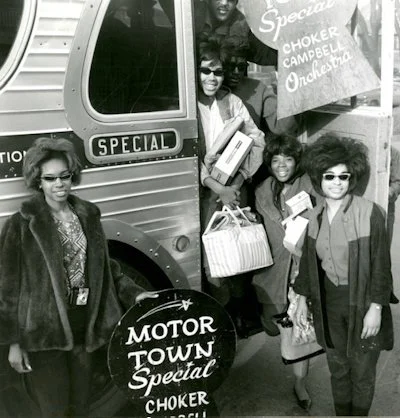
Hitting the road in October 1962: from left, Mary Wilson, Katherine Anderson, Rosalind Ashford, Wanda Young (photo: Motown Museum)
The business goes from amusement to respect when Robinson is appointed a vice president of Motown during the course of the year, and when the record he creates in October for his own group, “You’ve Really Got A Hold On Me,” becomes the Miracles’ biggest seller since “Shop Around.” (Two years later, the song’s presence on the second album by the Beatles ensures even greater royalties for Jobete Music than anyone could imagine in 1962.)
Not all of Berry Gordy’s decisions during this particular year are prudent. The introduction of the Divinity, Mel-O-Dy and Workshop Jazz labels does little or nothing for his firm’s revenues or profits, while a high percentage of the acts with singles released on the frontline Tamla, Motown and Gordy labels do not endure. Among them: Lee & the Leopards, Herman Griffin, Hattie Littles, Henry Lumpkin, the Valadiers, Mickey McCullers, Gino Parks, Mike & the Modifiers.
Then again, the youngster whose first 45 appears in May goes on to become the most influential superstar in the company’s history. “I Call It Pretty Music” by Little Stevie Wonder is the debut of a talent whose work proves to be more than merely pretty over the next five decades.
Internationally, Motown makes a modest but welcome British licensing deal with a fellow independent, Oriole Records, which begins in 1962 to release more singles – and albums – than the Detroit firm’s previous partners in the territory. U.K. airplay and sales are still relatively light, but the footprint is firm, and it makes at least one larger company, EMI, begin to take notice of the hits emerging from the basement studio of 2648 West Grand Boulevard.
Back in America, the launch of the Motor Town Special package tour of the chitlin’ circuit in eastern and southern states is another milestone. Record companies have seldom done any such thing in the past, and the ten-act roadshow (visiting 30-plus cities) not only attracts paying customers, but also develops and sustains vital relationships for Motown with radio stations, retailers and record distributors at a local level.
In other words, the tour helps Hitsville U.S.A. get its records played and get the company paid. What else matters?
Now, to the detail. Below is an account of 1962, subjective rather than exhaustive, to convey its flavour at the hands of Motown’s music makers and backroom believers. It’s divided into three sections: the first, a chronological run-down of significant dates during 1962, followed by examples of the year’s notable singles and album releases. If a 45 or album topped the Billboard R&B or pop charts – or both – that entry is shown in bold-face italics.
MOTOWN 1962
January: Diana Ross graduates from Detroit’s Cass Tech High School, Mary Wilson graduates from Northeastern High. Both signed contracts with Motown the previous year.
January 3: Berry Gordy acquires 2650-52 West Grand Boulevard for his expanding business; it becomes his office location, and that of his sister, Esther Edwards.
January 13: Motown now has more than 35 people on its payroll, according to Norfolk’s Journal & Guide, in a short article about the firm’s success. The same edition reports that Claudette Robinson recently had to be hospitalised in Detroit for toe surgery. Soon afterwards, Motown shares with the trade press a photograph of Robinson on crutches.
January 17: The Supremes undertake their first studio session as a trio (Barbara Martin having left in December) with “Play A Sad Song,” written and produced by Berry Gordy. It’s included on the group’s first album, Meet The Supremes, released later this year.
January 24: Smokey Robinson and Berry Gordy are among the honourees at the annual awards ceremony of performing rights organisation BMI. Their recognition is for the Miracles’ “Shop Around,” based on its airplay and other measures of popularity in 1961. Another Jobete Music winner is “Please Mr. Postman” and its songwriters. The awards event takes place at New York’s Pierre Hotel.
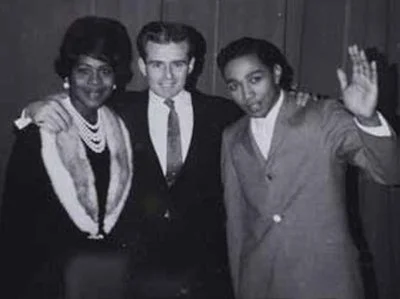
In San Francisco: Gladys Horton, Barney Ales, Eddie Holland
January 27: Eddie Holland and the Marvelettes are among the acts booked for “a song and dance jamboree” at San Francisco’s Cow Palace. Motown sends Holland and the group’s Gladys Horton to the city, but recruits four Bay Area girls to back her on stage. “We didn’t have the money to fly the whole group from Detroit,” says the company’s Barney Ales, years later.
February 12: Eddie Holland performs “Jamie” on American Bandstand.
February 21: Orlando’s Harvey Pylant is signed to Motown, according to the city’s Evening Star, and will record “The Lift Off” shortly. He is a director and announcer on Daytona Beach’s WESH-TV. (In the event, the 45 is released by Orbit Records, not Motown.)
March 4: The Marvelettes appear on television’s American Bandstand, performing their “Twistin’ Postman” follow-up to “Please Mr. Postman.” The single is climbing the Billboard and Cash Box pop charts.
March 16: Motown launches the Gordy label with the Temptations’ “(You’re My) Dream Come True.” Later this month, the company’s national sales manager, Barney Ales, tells Cash Box that Gordy is the new name for Miracle, which put out its final 45 last October. The change, he says, is because of “confusion” over the label’s identity and that of Motown’s hitmaking act, the Miracles.
April 5: Lamont Dozier records “Fortune Teller (Tell Me),” working with Freddie Gorman and Brian Holland, who later notes that this was one of the first occasions that he and Dozier collaborated.
April 26: Sam Cooke records “Bring It On Home To Me” in Los Angeles, which inspires Smokey Robinson to write and record “You’ve Really Got A Hold On Me” soon after hearing Cooke’s hit. During their concert set, the Miracles segue from the latter song into the former.
May 5: Motown’s national sales manager, Barney Ales, is promoted to vice president, according to Billboard, while retaining his previous responsibilities. He joined the firm in 1961.
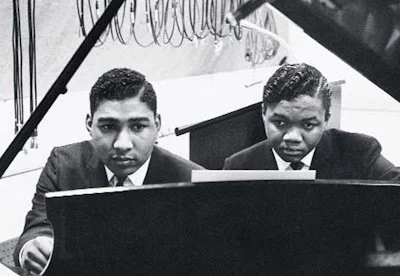
Brian Holland and Lamont Dozier in Studio A: the start of hitmaking history
May 12: The Workshop Jazz label makes its debut with a single, “Exodus,” by Hank & Carol Diamond. Washington’s All Star Jazz is the imprint’s first album release, out in 1963.
June 15: Lamont Dozier’s “Dearest One” is released on Motown’s new Mel-O-Dy label, the day before his 21st birthday. It’s thought to be one of the first – if not the first – song created by Holland/Dozier/Holland as a team.
July: Martha Reeves joins Motown as secretary to A&R chief Mickey Stevenson. “She managed the phones, the artists and the musicians without going crazy,” Stevenson later recalls. “Martha kept my sessions in good order as well.”
July: Berry Gordy appoints Smokey Robinson as a Motown vice president, surprising him with the announcement of the promotion during a staff meeting (of indeterminate date) at Hitsville.
July 31: The Wright Specials have the first (and the only one this year) of a handful of 45s issued on Motown’s newest offshoot, Divinity. “That’s What He Is To Me” is written and produced by the gospel label’s supervisor, George Fowler.
August 19: Motown sponsors the closing night banquet of the National Association of Radio Announcers (NARA) at the Sheraton-Jefferson Hotel in St. Louis. The organization represents black disc jockeys.
September 2: At Detroit’s Coliseum arena, Marvin Gaye plays one of the final shows of this year’s Michigan State Fair, days before recording his next hit, “Hitch Hike.”
September 13: The Supremes cut “I’m Giving You Your Freedom,” their first recording of a Holland/Dozier/Holland song, produced by Brian and Lamont.
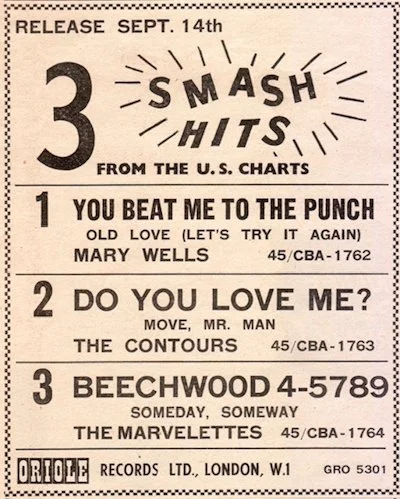
Britain’s Oriole Records begins its Motown relationship
September 14: The first Motown release under a new, one-year U.K. license deal with London’s Oriole Records is “You Beat Me To The Punch” by Mary Wells. “We plan at least three [Motown singles] a month,” Oriole A&R manager John Schroeder tells Billboard.
September 15: Motown enjoys its best chart week to date with five hits on the Billboard Hot 100, including two (Mary Wells’ “You Beat Me To The Punch,” the Marvelettes’ “Beechwood 4-5789”) in the Top 20.
September 22: The Marvelettes’ “Beechwood 4-5789” peaks at No. 17 on the Billboard Hot 100. It’s said to be the first major hit with a telephone number for a title since Glenn Miller’s “Pennsylvania 6-5000” in the 1940s.
September 25: The Four Tops perform on NBC-TV’s The Tonight Show, hosted by Donald O’Connor. The following April, they sign to Motown.
October 13: Amos Milburn records “My Baby Gave Me Another Chance” with producer Clarence Paul, and Motown announces the bluesman’s signing a few weeks later. The track is released as a 45 the following March.
October 20: Billboard reports that Motown has taken on distribution of Harvey Fuqua’s Harvey label, with promotion for its current release, “Cleo’s Mood,” by Jr. Walker & the All Stars.
October 26: The “Motor Town Special” package tour kicks off its autumn run with a one-week booking at the Howard Theater in Washington, D.C. Featured acts are Mary Wells, the Miracles, Marv Johnson, Mary Wells, the Marvelettes, Marvin Gaye, the Supremes, the Contours, the Vandellas and Singin’ Sammy Ward, all backed by Choker Campbell and his “Show of Stars” band. The roadshow’s music makers travel in a bus and five cars.
October 27: Motown scores its biggest pop hit this year as the Contours’ “Do You Love Me” hits No. 2 on the Cash Box Top 100, only held from the top by Bobby “Boris” Pickett & the Crypt Kickers’ “Monster Mash.” On the Billboard charts, the single peaks at No. 3 one week earlier.
November 1: Jet magazine notes that the Miracles earn from $70,000 to $100,00 a year from touring. “As a result of their early recording hits,” it reports, “the demand for the Miracles and the Marvelettes was so great they toured the country on weekends by air.”
November 21: Motor Town Special tour manager Thomas “Beans” Bowles and his assistant, Eddie McFarland, are involved in an early-hours auto accident. Both men are hospitalised; McFarland dies a week later. A highway patrol officer finds $12,000 in cash in the car, being receipts from the roadshow, and returns it to Motown.
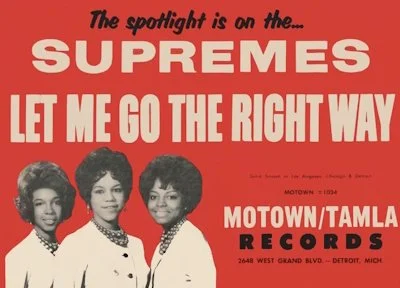
Looking for the right way: this one written and produced by the boss
November 30: It’s the eligibility cutoff date for contenders for the 1962 Grammy awards. Mary Wells’ “You Beat Me To The Punch” becomes Motown’s first-ever nomination (in the Best Rock & Roll Recording category) but loses out to Bent Fabric’s “Alley Cat” when the awards are announced the following May.
December 7: With a ten-day run at the Apollo Theater from this date, the Motor Town Special concludes Motown’s first package tour, including a midnight show on both Saturdays at the historic New York venue.
December 8: In New York, radio DJ Alan Freed pleads guilty to two counts of commercial bribery. He is later fined $300 and given six months’ probation. Freed was originally indicted in 1960 for accepting more than $30,000 in payola. His prosecution leads to a widespread investigation into the practice in the music and broadcasting industries.
December 22: Phil Jones joins Motown as its national album sales director, reporting to VP Barney Ales. He was previously at Detroit rackjobber Merchants Wholesale and, for eight years, Angott One Stop.
December 26: Little Stevie Wonder’s “Contract On Love” is Motown Records’ final 45 of the year. It goes Top 10 on Detroit’s WJLB in February, but makes no impact nationally.
December 26: Berry Gordy (“Detroit’s Record King”) is profiled in the Detroit Free Press. “We don’t accept an artist easily,” he says. “We look for character and integrity as well as talent, and this produces a big family-type organisation. We still have 98 percent of the performers we started with.”
Now, to the detail. Below is an account of 1962, subjective rather than exhaustive, to convey its flavour at the hands of Motown’s music makers and backroom believers. It’s divided into three sections: the first, a chronological run-down of significant dates during 1962, followed by examples of the year’s notable singles and album releases. If a 45 or album topped the Billboard R&B or pop charts – or both – that entry is shown in bold-face italics.
SELECTED SINGLES (by release date)
February 8: Mary Wells, “The One Who Really Loves You,” Motown 1024
March 12: Debbie Dean, “Everybody’s Talking About My Baby,” Motown 1025
March 16: The Temptations, “(You’re My) Dream Come True,” Gordy 7001
April 9: The Miracles, “I’ll Try Something New,” Tamla 54059
April 9: The Marvelettes, “Playboy,” Tamla 54060
April 14: Lee & the Leopards, “Come Into My Palace,” Gordy 7002
April 18: Eddie Holland, “If Cleopatra Took A Chance,” Motown 1030
May 8: Marvin Gaye, “Soldier’s Plea,” Tamla 54063
May 8: The Supremes, “Your Heart Belongs To Me,” Motown 1027
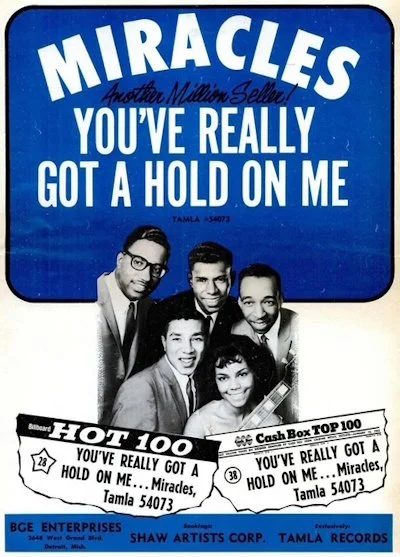
The Miracles return to the upper reaches of the charts
May 21: The Valadiers, “Because I Love Her,” Gordy 7003
June 15: Lamont Dozier, “Dearest One,” Mel-O-Dy 102
June 29: The Contours, “Do You Love Me,” Gordy 7005 (#1 R&B, #3 pop)
July 11: Mike & the Modifiers, “I Found Myself A Brand New Baby,” Gordy 7006
July 11: The Marvelettes, “Beechwood 4-5789,” Tamla 54065
July 17: Mary Wells, “You Beat Me To The Punch,” Motown 1032 (R&B #1, Pop #9)
July 23: Marvin Gaye, “Stubborn Kind Of Fellow,” Tamla 54068
August 16: Little Stevie Wonder, “I Call It Pretty Music But The Old People Call It The Blues,” Tamla 54061
August 17: The Miracles, “Way Over There,” Tamla 54069
September: Hattie Littles, “Your Love Is Wonderful,” Gordy 7007
September 24: The Pirates, “Mind Over Matter (I’m Gonna Make You Mine),” Mel-O-Dy 105
September 27: Martha & the Vandellas, “I’ll Have To Let Him Go,” Gordy 7011
October 1: The Temptations, “Paradise,” Gordy 7010
October 3: Little Stevie Wonder & Clarence Paul, “Little Water Boy,” Tamla 54070
October 29: The Marvelettes, “Strange I Know,” Tamla 54072
October 29: Mary Wells, “Two Lovers,” Motown 1035 (#1 R&B, #7 pop)
November 5: The Supremes, “Let Me Go The Right Way,” Motown 1034
November 9: The Miracles, “You’ve Really Got A Hold On Me,” Tamla 54073 (#1 R&B, #8 pop)
November 15: The Contours, “Shake Sherrie,” Gordy 7012
December: LaBrenda Ben & the Beljeans, “Camel Walk,” Motown 1033
December: Eddie Holland, “Darling, I Hum Our Song,” Motown 1036
December 19: Marvin Gaye, “Hitch Hike,” Tamla 54075
December 26: Little Stevie Wonder, “Contract On Love,” Tamla 54074
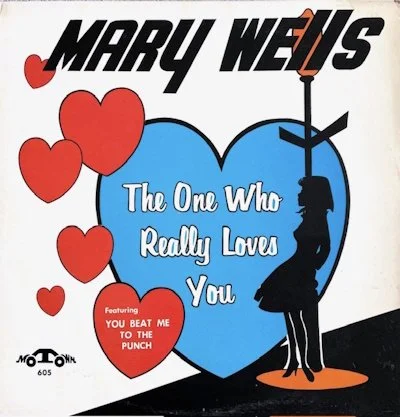
Mary Wells’ “chalypso” beat…
SELECTED ALBUMS (by month of release)
April: The Marvelettes, The Marvelettes Sing, Tamla 229
May: Eddie Holland, Eddie Holland, Motown 604
May: Various, Motown Hits Vol. 1, Motown 603
June: Mary Wells, The One Who Really Loves You, Motown 605
July: The Miracles, I’ll Try Something New, Tamla 230
July: The Marvelettes, Playboy, Tamla 231
September: Little Stevie Wonder, The Jazz Soul Of Little Stevie, Tamla 233
October: Little Stevie Wonder, Tribute To Uncle Ray, Tamla 232
October: The Contours, Do You Love Me, Gordy 901
Music notes: the diversity of Motown’s studio sessions in 1962 – including its gospel and jazz recordings – was wonderfully captured by a series of digital albums put onto streaming services by Universal Music in 2012. These include Motown Unreleased 1962: Jazz (two volumes), Motown Unreleased 1962: Gospel, Motown Unreleased 1962: Guys (also two volumes) and Motown Unreleased 1962: Girls. Nothing better illustrates the company’s musical breadth at that point in time, which, of course, became significantly narrower as its artists began to turn into stars, not merely hopefuls.
Credit notes: sources for this timeline are, among others, Joel Whitburn’s Billboard and Cash Box chart books from Record Research, Mary Wilson’s Dreamgirl and Peter Benjaminson’s The Story of Motown, Laurent Bendele’s Diana Ross/Supremes website, and the peerless liner notes for Universal Music’s The Complete Motown Singles series.