A Reverend of Influence
BERRY GORDY: JESSE JACKSON WAS ‘FAMILY’
“There is,” wrote Rev. Jesse Jackson, once upon a time, “a remarkable example of how decency can be more profitable than decadence in a black recording company – Motown, the corporate creation of Berry Gordy.”
The much-respected civil rights leader had been publicly complaining about the proliferation of songs with crude or explicit lyrics (“syncopated pornography,” he called them) which were broadcast on radio stations nationwide “and then in the heads of our children, undermining and devaluing morals and emotions.”
As examples, Jackson cited Donna Summer’s “Love To Love You Baby,” Johnny “Guitar” Watson’s “Ain’t That A Bitch” and Elton John’s “The Bitch Is Back.” It was 1977, and he was on a campaign against the spread of such “musical garbage,” to use his rhetoric from an opinion piece widely published in newspapers of the day.
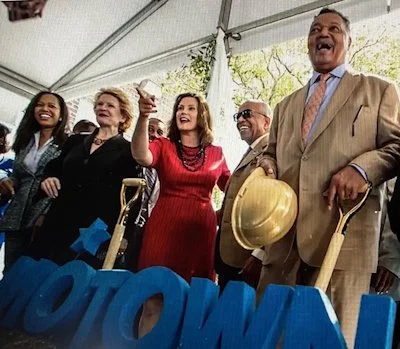
Jesse Jackson, helmet in hand: breaking ground for Hitsville Next (photo: Motown Museum)
The music of Motown, added Jackson, was in sharp contrast, made by artists and songwriters who adhered to “an enduring tradition of music as a medium of inspiration, social uplift and joy.” In particular, he cited two acts: the Jackson 5 (“a positive projection of a family as an intact, responsible unit in society”) and the Supremes (“a wholesome team of teen-age neighbours [who] climbed from a ghetto housing project to international popularity”).
Nevertheless, this was one of the few Jackson campaigns which gained no significant traction. Today, it serves as a reminder of the high regard in which he held Berry Gordy’s business, and the man himself. The two had become acquainted 14 years earlier, “and it was Jesse who brought Dr. King to Hitsville in 1963, just days before the historic Great March to Freedom in Detroit – a moment which forever connected music, movement and mission.”
Those words were part of the Motown founder’s tribute to Jackson upon his death earlier this month. “He was family,” declared Gordy. “He stood with me, with my family, with Motown, and with our community through moments of hope, struggle and profound change.”
The reverend enjoyed the social company of Gordy’s stars, too. In early 1969, he invited Diana Ross, Mary Wilson and Cindy Birdsong to his Chicago home for a soul food feast. At another time, he attended a tenth anniversary party for the Temptations. And in 2005, he was clearly delighted to have an unrelated Jackson – Michael – as a guest on his nationally-broadcast, Sunday morning radio show, Keep Hope Alive. “Remember when we met on 47th Street way, way many years ago?” he asked the music superstar. “Your father brought you and the guys by the office in your station wagon and U-haul. You were performing at the Regal Theater.” Jackson the younger did remember it, then recalled something else about his host: “You had a big Afro at the time.” “Don’t remind people of that, Michael” came the reply.
Jesse Jackson became well-acquainted with other Motown artists, including Marvin Gaye and Stevie Wonder. Moved upon hearing What’s Going On, he told Gaye that the album made the singer “as much a minister as any man in any pulpit.” And Jackson also knew one of Gordy’s “political” lieutenants: Junius Griffin, a former director of public relations for Dr. Martin Luther King’s Southern Christian Leadership Conference (SCLC), who joined Motown in 1967. Jackson and Griffin went together to the 1972 Democratic National Convention in Miami Beach.
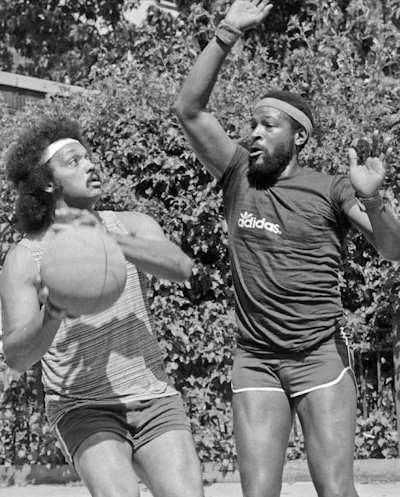
A competitive pair: Jesse Jackson and Marvin Gaye
When King was assassinated in 1968, Gordy arranged for Wonder, the Temptations, Gladys Knight & the Pips, and Diana Ross & the Supremes to perform at a memorial benefit in Atlanta that June.
The next year, he supported Rev. Jackson’s Operation Breadbasket – a SCLC offshoot which promoted black employment by businesses operating in black communities, such as supermarkets – and sent another quartet of Motown acts to perform at its first Black Business & Cultural Exposition in Chicago: Marvin Gaye, the Four Tops, Martha Reeves & the Vandellas, and the Originals. Motown even had an exhibit booth at the event, with company staffers Karen Hodge and Jeana Jackson among those on hand.
Also in 1969, Gordy endorsed the Folk and Art Festival in Gary, Indiana, and arranged for Reeves & the Vandellas, the Originals, Bobby Taylor, Blinky and – of course – the recently-signed Jackson 5 to perform there, free of charge. Jesse Jackson’s Operation Breadbasket Band and Chorus, led by Ben Branch, were featured in the concert, too.
Two years later, Jackson split from the SCLC to form a new national organisation, People United to Save Humanity (PUSH), to promote economic development for black and poorer citizens. Gordy joined its board of directors, and became involved in the PUSH Expo ’72 which followed in Chicago in October. He gave a keynote speech at a pre-Expo national businessmen’s breakfast – which, reportedly, netted him a standing ovation – and despatched various Motown stars to play during the five-day event. Among these were Marvin Gaye, the Supremes, the Temptations, Gladys Knight & the Pips and the Jackson 5, major attractions all.
During the PUSH exposition’s planning stage, influential music manager Clarence Avant sought to have the artists’ performances filmed, an initiative that – with the help of a Ford Foundation grant of $750,000 – led to the production of a Paramount Pictures movie, Save The Children. Obviously, it took its theme from the What’s Going On track of that name – not least because Gaye himself performed it during one of the Expo ’72 concerts in the Windy City. Financing of the film also owed much to Berry Gordy and Stax Records’ chief, Al Bell.
Subsequently, Motown Records secured the soundtrack rights, and issued an album, Save The Children, in April 1974. The 2LP package included extracts from the live sets by Gaye, the Temptations, Knight & the Pips and the Jackson 5, as well as tracks by the O’Jays, Bill Withers, Roberta Flack and Curtis Mayfield, among others. Also, excerpts from Jesse Jackson’s oratory at the original event.
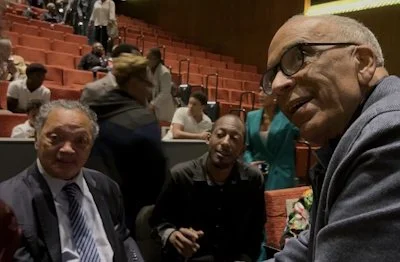
Jesse Jackson with Stan Lathan at the re-release of Save The Children (photo: Alan Elliott)
Directed by Stan Lathan, Paramount’s Save The Children was released theatrically in September 1973 to modest box-office numbers, and might have subsequently been lost to history but for the excavation efforts of Lathan and Alan Elliott, producer of the Aretha Franklin film, Amazing Grace. As a result, the movie was picked up and re-released in 2024 by Netflix, preceded by a special screening at the 60th anniversary edition of the Chicago International Film Festival.
“This is the only film footage – not TV footage, but film footage – of the Jackson 5 in 1972,” Elliott told Variety, “and they are the biggest thing in the world at that time. They are Taylor Swift, they are the Beatles. At that time, they are riding a wave of those five or six huge hit records, and when they go on stage and the kids rush the stage, it’s hilarious.” When the Netflix reissue was screened at the Chicago movie Festival, Jesse Jackson and his son Yusef were present.
“My father wanted to put together an Expo that showed African American talent and grace as we began to unify the country and eliminate some of the lines that divided us,” Yusef later explained. “So he put together an exposition in Chicago — not on the coasts, [and] at the height of the Mayor Daley years — where he brought together black vendors, business people and artists, and used an all-black cast and crew to record such an event. There were questions. ‘Can African Americans do this?’ The answer was, of course, we can do it. ‘Do we have the talent on the artist stage?’ Of course we do. ‘Can we unify and pull it all together?’ Of course we can.”
Another significant music industry moment for Jackson was in 1986, when Motown’s founding father decided to sell his record company. The reverend was one of the black political leaders who told Berry Gordy that if he must do so, he should cut a deal with a black-financed consortium. “Unconfirmed are reports that both Stevie Wonder and Lionel Richie also sought to sway Gordy against the sale,” I wrote at the time for trade paper Radio & Records. I also got a “no comment” from Jackson.
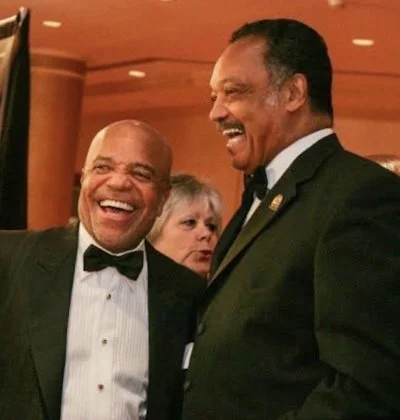
Berry Gordy, Jesse Jackson at a Motown 50 celebration (photo: Kimberly P. Mitchell, Detroit Free Press)
In the event, Gordy cancelled the transaction he had agreed with MCA Records that December – but returned to the bargaining table 18 months later, and consummated the sale. (This, despite the fact that another prominent black businessman, Dick Griffey, tried to acquire Motown in an 11th-hour bid.) “Berry Gordy and the purchasers of Motown Records’ assets have provided an opportunity for continued black ownership in the new company,” declared MCA’s official announcement about the deal on June 28, 1988.
There’s little doubt that Jesse Jackson had influence on that aspect of the final transaction, and the following February, Diana Ross acquired an equity stake in Motown Records under its new owners. Respected black music executive Jheryl Busby, appointed as label president after the sale, was already thought to hold a 10 percent equity interest.
Not that Jackson lost interest in Motown and the Gordy family from that point on. At the Motown Museum, “he was a frequent and welcome presence,” the institution declared about his February 17 passing, “always offering encouragement, wisdom and kindness to everyone he met. His visits, and his steadfast belief in our mission, meant more to us than words can express.”
Gordy and Jackson had attended each other’s birthday celebrations on various occasions, including last year’s party marking the former’s 96th. And when the Motown Museum announced its latest expansion plans in 2019, Jackson was present to help break ground on the new Hitsville Next centre.
“Jesse Jackson,” said Berry Gordy, “was a force of history, a moral voice, a builder of bridges, and a champion for those whose voices were too often ignored. His legacy will live on not only in books and speeches, but in the lives he touched and the progress he helped make possible.”
Relative notes: another of Jesse Jackson’s music connections is that his half-brother, Charles “Chuck” Jackson, was a successful songwriter/producer for Natalie Cole, among others (and not to be confused with R&B singer Chuck “Any Day Now” Jackson). Four years younger than Jesse, he got started at Jerry Butler’s songwriters’ workshop in Chicago in the early 1970s, later becoming a member of the Independents (“Leaving Me”). Thereafter, he and fellow group member Marvin Yancy teamed up to write and produce a series of breakthrough hits for Cole, including “This Will Be,” “Inseparable” and “Sophisticated Lady.” Jackson once recalled that he and his brother “were kind of serious kids. And we were very poor. Capital P.”
Music notes: Motown’s Save The Children soundtrack album is not officially available on digital streaming services, but other recordings of Jesse Jackson’s memorable rhetoric are, including a speech given at Wattstax in August 1972 which echoes his Chicago eloquence. Also, the Netflix reissue of the Save The Children film includes some performances not contained in the original soundtrack album, by the Staple Singers, the Chi-Lites and Cannonball Adderley, among others.