Stepping Up from Studio A
THE WOMEN BEHIND THE SOUND OF YOUNG AMERICA
More than 25 years into the 21st century, it’s rare to find a new book offering first-hand, finely-detailed and evocative insights into the music of Motown, and the people who made it.
One Step Away by Louvain Demps is one such adventure.
It arrives in a matter of weeks from publisher Harper Collins with a subtitle (My Story of the Andantes, Motown and the Women Behind the Sound of Young America) and the considerable credentials of Demps’ co-author, Paul Milliken. He is a professional journalist, an Emmy-winning feature and entertainment reporter for Atlanta’s Fox 5 TV station, who also created the highly-regarded blog, The Diana Ross Project.
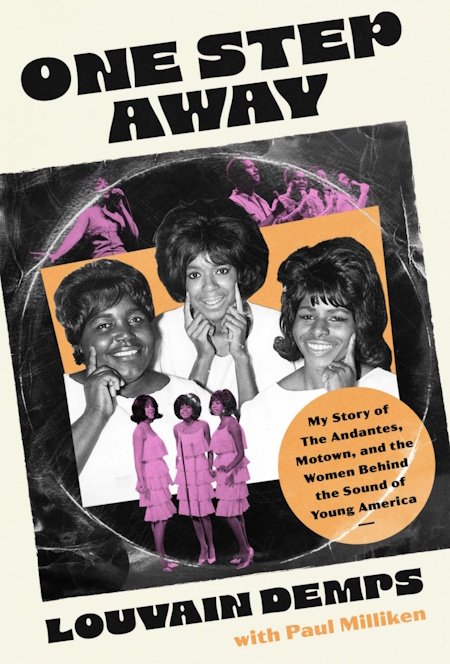
One early review of One Step Away calls it “an important corrective to the history of American music and a belated recognition of three women who contributed enormously to the Motown Sound.”
To those of you reading this, the word “belated” is unlikely to apply. Motown followers have long recognised how important were the Andantes to the magic created in Studio A at 2648 West Grand. Moreover, Demps, Jackie Hicks and the late Marlene Barrow were documented in detail in Motown From The Background, an authorised biography of the group by Vickie Wright, published in 2007.
“At the time,” Demps recalled for me the other day, “Jackie and Marlene told me they only did that book because I kept asking – and they were ready for me to stop asking! So, for this one, I did what I’ve always wanted to do. I did it my way.”
An example of that? “I don’t think Jackie, Marlene and I ever sounded better than we did singing with Kim Weston,” she writes in One Step Away. “Her voice was so powerful that we could really ‘show out’ without any fear of upstaging her, and – probably due to her gospel roots – she really loved that big, choral sound that we could provide.”
What Demps calls “the world’s first taste” of Kim Weston backed by the Andantes came with the release of “Love Me All The Way” in 1963. “When Kim toured, she wanted us onstage with her. And not behind a curtain, either. She made sure the audiences saw our faces and heard our voices loud and clear. We started doing some dates with Kim, performing at places like the 20 Grand and the Fox Theatre in Detroit. There’s a famous picture of us standing on steps behind Kim – we’re wearing black satin skirts and white tops and very, very large white bows in our hair – which I remember being taken at the first show we’d done with her.”
In addition to Weston, the Andantes genuinely connected with the Four Tops and Marvin Gaye. “With the Tops,” Demps told me, “it was because they could sing. They could harmonize. Lawrence [Payton] had an ear – perfect pitch. And in our group, Marlene had perfect pitch. And they were not show off-ish. They were confident in what they were doing. They were just wonderful.”
SINGING IN THE DARK
Of Gaye, she recalls, “When Marvin produced, he was tops. What’s Going On was a magical thing. He insisted that we sing in the dark. He did not want any lights on. And it was a hard session because we had never had a session like that, where it was so intricate. It was things that nobody else had requested of us – things that he could hear [in his head], and we had to produce what he heard. It was just different.”
Co-author Milliken’s writing skill amplifies such memories. “I wrote things down on all kinds of things, scrap papers and toilet paper and stuff!” Demps says. “I didn’t keep a diary, but I did have a lot of notes. I love deeply. And things that are really deep within you, you don’t forget very easily. And in a moment of loneliness, sadness, or something comes up, you go back to that good time, the thing that you love.”
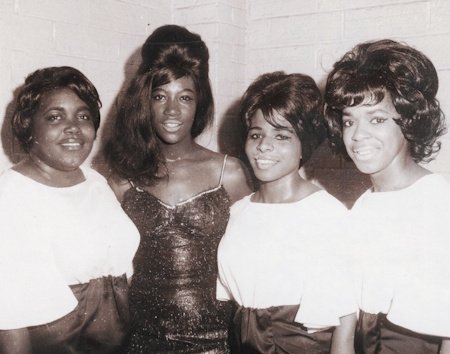
Kim Weston with the Andantes: (l-r) Jackie Hicks, Marlene Barrow, Louvain Demps (photo: Louvain Demps Collection)
One Step Away has been five years in the making. “Louvain called me in the spring of 2021,” Milliken remembers, “and said she was ready to write her memoir, and asked if I’d be her partner on the project. And, of course, it didn’t take me but two seconds to say yes, because I love her and would do anything for her.”
Milliken and Demps have been friends for almost ten years – both live in Atlanta – which came about when the broadcast journalist did a well-received TV feature about her in 2017. For the book, he says, “Louvain and I spent hours and hours talking about her life and career. We got to know each other in a very deep way, and were always on the same page about how her story should be told.” As noted, Demps saved a lot of material from her Motown days, including pay stubs and records on which she sang. “She has a vast collection of 45s and LPs.”
She also has abiding memories of what Milliken calls Motown’s hidden figures. “So, we spoke with wonderful singers and musicians,” says her co-author, “including Stuart Avig, Gino Parks, Paul Riser and Jimmy Roach – people to whom Louvain felt particularly close at Motown, and felt could offer the best insight about the Andantes.”
Another such hidden figure was studio engineer Mike McLean. “Oh, man, he set up the whole thing!” explains Demps. “He made the changes where the musicians in the studio stood. He put together where the microphones would go and stuff. He was very knowledgeable. The only thing that he didn’t consider was the toilets flushing! He placed an echo chamber in the spot where, if anybody went to the bathroom and if they flushed the toilet, it would ruin the take! And so, you know, you’d go to the bathroom before you’d go to work! But he was really great.”
PAIRING OFF WITH THE GUYS
There are other little-known angles in One Step Away. “As the Temptations became more popular and established their own sound,” Demps writes, “they didn’t want any other voices featured on the records with them. Eventually, I heard that one of the guys went to Berry and asked that the Andantes stop appearing on their records, and Berry agreed.
“Jackie, Marlene and I hated not being able to spend time in the studio with those guys any more because they were so much fun and so talented…but we understood. They wanted to sound onstage exactly as they sounded on their records.”
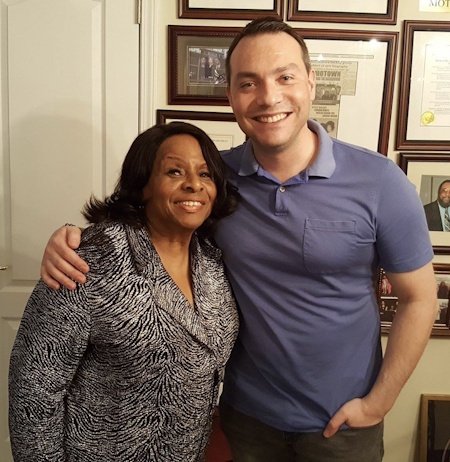
Louvain Demps and Paul Milliken, 2017
By contrast, the Andantes were integral to the sound of the Four Tops. “We always paired off with the guys,” Demps recalls in the memoir. “Duke Fakir was the tenor, so he and I stood together; Lawrence Payton, who had perfect pitch just like Marlene, paired with her; Obie Benson was the group’s bass, so he and Jackie were together. Levi Stubbs was the lead singer, but he was always there in the studio, too, and added to the backgrounds.”
There is much more to One Step Away – not least the trio’s experience with Motown’s biggest act. “Jackie, Marlene and I had recorded material with and for the Supremes since the beginning,” Demps remembers. “On the earlier material, we laid down vocals to make the sound larger and more robust; we weren’t singing in place of the Supremes, just adding to the mix. But once the group started touring non-stop, the producers found it much easier to just let us handle the backgrounds, limiting the amount of time the girls were needed back in Detroit.”
The recording of “Love Child” was an example. After hearing the full song, with Berry Gordy in charge in the studio, the Andantes went about arranging their parts. “This was a record heavy on the backgrounds; Jackie, Marlene and I really got to do some strong, soulful singing, which we loved. And then came the mistake.”
That in itself was rare, as Demps acknowledges. “If one of us was going to stray off the path, it would be Louvain ‘Don’t Sing Here’ Demps! But after running through the song a few times, there was one take – one take – during which Jackie and Marlene forgot to come in on that three-part harmony. So, I wailed out my note, suddenly realising that I was singing solo. Playback stopped, and one of the producers asked what had happened. Before anyone could answer, Berry called out, ‘Wait a minute!’ He rewound the tape and listened to it, up through my ‘solo scream.’
“ ‘We’re going to keep it that way,’ Berry announced. And he looked at me. ‘Girl, you sure can sing.’ ”
In One Step Away, the compliment rings true for how Louvain Demps can remember. In 2026, that’s no mean feat.
Music notes: the chapters in One Step Away are named after tracks on which Louvain Demps and/or the Andantes sang, beginning with Barrett Strong’s “Money (That’s What I Want).” And so they form the basis of this Spotify playlist, concluding with – what else? – “One Step Away,” which Demps co-wrote, and was recorded by Gladys Knight & the Pips in 1971.
Speaking notes: Louvain Demps and Paul Milliken are due to talk about One Step Away on December 9 at the Atlanta History Center. There currently don’t seem to be any plans to stream the event.