A Gallery of Stars
MOTOWN IN THE SMITHSONIAN
Perhaps he’s just been told that Dreamgirls won six Tony awards…
Berry Gordy’s facial expression, shown below, leans towards puzzlement, with a hint of concern. The shot was taken on an undetermined date in October 1982 by photographer Peter Strongwater, soon after the Motown founder had given responsibility for running his record company to an outsider, Jay Lasker.
Whatever the moment, this intriguing photo is one of eleven Motown-related images held and housed by the Smithsonian Institution’s National Portrait Gallery (NPG) in Washington, D.C., and periodically displayed there. Several are familiar, such as Francesco Scavullo’s angular perspective of a wet-haired Diana Ross, as seen on the cover of her Diana album, and Jim Britt’s evocative image of a ruminating Marvin Gaye, taken while he recorded his album, Let’s Get It On.
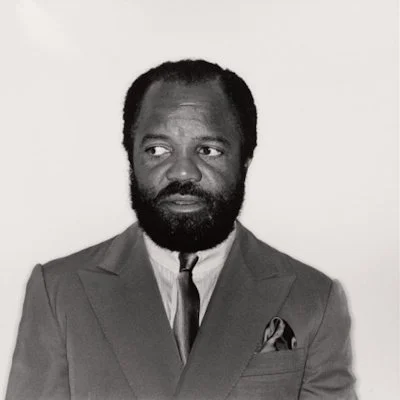
National Portrait Gallery, Smithsonian Institution; gift of Christopher Murray © Peter Strongwater/Govinda Gallery
Several other Motown photographs in the gallery’s collection are intriguing, such as one connected to a concert by 18-year-old Stevie Wonder (of which more shortly), while there are few more endearing than Bruce Davidson’s image of the Supremes at work in the Hitsville U.S.A. studio, singing together, with saxman Hank Cosby hinting at a solo to come.
Actually, Davidson may just be the most satisfying and honest of all the outside photographers who captured the women and men of Motown at work, at play and at rest during the company’s ’60s heyday. Chicago-born Davidson had already accumulated a powerful portfolio of pictures, taken when he joined a group of young Freedom Riders travelling by bus in the American south and campaigning for civil rights and racial justice. That was in 1961. Four years later, Berry Gordy allowed him to shoot some of the most informal and illuminating photos of the Supremes. One of those, shown below, figured in the NPG’s travelling exhibition, Women of Our Time: Twentieth Century Photographs from the National Portrait Gallery, which criss-crossed the U.S. from 2003-2005.
Another Davidson snap shows the trio cavorting in front of 2648 West Grand Boulevard, spontaneously throwing snowballs at each other during a typical Detroit winter’s day. “They must have liked me,” he told CNN’s Benazir Wehelie in 2015, “because they didn’t throw any snowballs at me.” He added, “I was lucky to be accepted in a certain way. But also aware that there was something going on in the air.” Davidson continued, “I was able to come close and personal because somehow, they trusted my eye. They allowed me, with my little Leica camera, to photograph. Whether it was performing, whether it was looking at themselves in the backstage mirror or whether it was resting between performances, sitting on a bed. I was allowed and no one closed any doors.”
This candid imagery extended to black-and-white shots of Ross, cigarette in hand, relaxing in a New York hotel, chatting to Florence Ballard, and of Berry Gordy, with a disapproving expression on his face seemingly aimed at the photographer, as he sat backstage on an Apollo Theater bed, Ballard lying on it beside him. “I just tried to be invisible, and I was invisible to them,” Davidson said. “They didn’t in any way affect my being able to be a kind of fly on the wall…I was there to observe an aspect of their life as musicians.”

National Portrait Gallery, Smithsonian Institution; © Bruce Davidson/Magnum Photos
In addition to its Supremes-in-the-Snakepit moment, the National Portrait Gallery holds two other 1965 depictions of the group. One is by photojournalist Steve Schapiro, joyously framing them on television’s Hullaballoo on May 2 (filmed in New York, the show was broadcast on May 11). This was first displayed at the NPG in 2008-2009. The other is a poster promoting their October 15 appearance at Lincoln Center’s Philharmonic Hall, also in New York. It was created by fashion illustrator Joe Eula, and became a firm fan favourite.
Ross’ solo career is represented in the D.C. collection by the 1979 Scavullo photo mentioned above, and by Bill King’s 1973 portrait of her in one of the Blackglama series of “What becomes a legend most?” mink coat advertisements. These were designed to reinforce the unique quality of fur as a privileged fabric for privileged people; other stars who appeared in the ads included Barbra Streisand, Rudolf Nureyev, Liza Minnelli, Lauren Bacall – and Ray Charles. “When we arrived at Bill King’s studio,” wrote ad agency boss Peter Rogers in his What Becomes a Legend Most? book, “Diana showed us everything she’d bought (including ‘an Afro wig the size of a serving platter’) and said, ‘Okay, I’m in your hands. Just tell me what to do.’ We did, and she did it. The shoot was one of the best ever – and certainly one of the most fun. Ross sang and danced for about an hour, and Bill got an action shot so vibrant, it practically pops off the page.”
‘FLY ON THE WALL’
The only in-house Motown snapper whose work is held by the National Portrait Gallery is Jim Britt, and it’s his well-known image of Marvin Gaye at the piano which resides there. It was taken in June 1973 in Los Angeles during the vocal sessions for Let’s Get It On. “In those days, I would shoot both black and white and colour all the time,” Britt once recalled. “I remember being there all day, and at the end of the day, Marvin asked me if I shot any photos! I guess I could be the fly on the wall even at 6’ 2”. I shot at least ten rolls of each film.” The Gaye studio shot was featured in the NPG’s American Cool exhibit in 2014.
Two Jackson 5 images in the D.C. institution have little or no information about the source. One depicts the group performing on The Sonny and Cher Comedy Hour on September 15, 1972 (it was displayed at the NPG in 2014-15); the other shot features the brothers standing together in colourful outfits at an unknown location. The latter is thought to have originally been used for a Jackson 5 poster, produced by Gemini Rising, Inc. There is also an Andy Warhol painting of Michael Jackson kept in the collection, but it was done long after he left Motown.
National Portrait Gallery, Smithsonian Institution; gift of Jack Rennert; © Milton Glaser
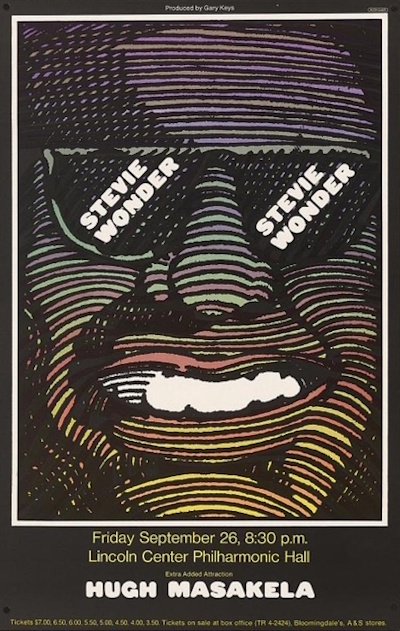
And what of Wonder? Oddly, there is at present no photograph of Stevie in the Washington gallery, but there is an intriguing poster for a concert of his at New York’s Lincoln Center on September 26, 1968. It displays a drawing of the musician’s face, defined by a series of colourful, horizontal lines, with his name burnished onto his dark glasses. This is the work of renowned graphic designer Milton Glaser, who created more than 400 posters during his career, as well as the globally recognised “I Love New York” logo and much more besides.
The name of the opening act for Wonder’s show also appears on the advertisement, albeit misspelled: South African jazz musician Hugh Masekela. He had relocated to the U.S. years earlier, and drew audiences to clubs and concert venues across the country, including the Lincoln Center in May 1967. The poster for that gig was designed by Glaser, too.
“We knew Stevie quite well,” says Masekela’s longtime musician friend and co-founder of Chisa Records, Stewart Levine. “In the fall of 1966, when we came to California from New York, we were living in the hills,” he told me recently. “Martha Reeves was a friend of Hugh’s and mine, particularly Hughie. She was lovely.
“We had no furniture in the Hollywood Hills house, but we had a piano, and Martha came over with Stevie. We hadn’t met him yet, and she was like a big sister to him. He was delightful, and then he sat at the piano and played maybe a dozen of the songs that were to become Talking Book and all that. He had ’em then, man – at least bits and pieces of them. It was shocking. So they became fast friends, Hughie and Stevie, and that’s how he ended up on the [Lincoln Center] show.” The following year, Chisa signed with Motown for U.S. distribution.
In addition to Berry Gordy, there is a onetime member of Motown’s backroom team in the National Portrait Gallery: Suzanne de Passe. She spent 24 years in Gordy’s employ, first as a creative assistant working, in particular, with the Jackson 5, and then rising in the ranks to be centrally involved with the company’s movie and TV production arm, as detailed here. The gallery photo was taken by Timothy Greenfield-Sanders in 2008, when de Passe and veteran producer Madison Jones formed de Passe Jones Entertainment. The next year, the firm produced the Commander in Chief’s inaugural ball for President Barack Obama.
SMOKEY, TEMPTATIONS, STEVIE?
It has to be said that none of the Motown images are currently on display at the National Portrait Gallery, but it regularly presents themed exhibits and so it’s likely that some will appear in future. The photos and posters are also viewable online at https://npg.si.edu/
Notwithstanding all that, there are one or two surprising Motown omissions in the Washington collection – most notably, Smokey Robinson. Among the most memorable photos of the singer/songwriter is one taken in late 1964 by Don Paulsen, with a dressing gown-clad Robinson shown teaching the Temptations a new song, backstage at the Apollo. (It was, of course, “My Girl.”) As for Stevie Wonder, a photo (rather than a poster) which merits attention finds him at New York’s Electric Lady studio in New York, sitting on a high stool, playing his harmonica into a microphone. It’s quintessential Wonder. Perhaps Getty Images will consider gifting the latter to the National Portrait Gallery, and Paulsen’s daughter donating the former.
After all, a picture is worth 1,000 words, right?
Near-litigation notes: Berry Gordy’s objections to the stage and movie musical Dreamgirls and the fictional story’s parallels with Motown (and with him personally) were known at the time. When the film version came out in 2006, there was a real prospect of litigation against the studios responsible, which was only alleviated when they publicly apologised (in trade press advertisements) to Gordy for any “confusion.” His main objection? “The film,” he said, “implied that a black man couldn’t build something like a Motown without being a crook.”
Visual notes: there have been a variety of coffee-table books showcasing the visual history of Motown’s music makers. One of the first was 1990’s The Motown Album, with a foreword by Berry Gordy, while 2009’s French-language Motown Soul & Glamour was the work, in part, of Motown aficionado Gilles Pétard. In 2017, the Jacksons celebrated their 50th anniversary in photographs in Legacy, with the help of author Fred Bronson, while Mary Wilson, with Mark Bego, created 2019’s Supreme Glamour, featuring full-colour images of the group’s many costumes and stage outfits. And (ahem) there is also 2015’s Motown: The Sound Of Young America, my book with Barney Ales, which includes an extensive range of photos from the company’s heyday, including the above-cited work of Bruce Davidson.
Appreciation notes: thanks to Gabbie Obusek at the Smithsonian Institution for guidance and detail on this subject, and to Supremes experts Stephen Woods and Laurent Bendele for date verification.