A Motown Timeline: 1982
RICK JAMES, LIONEL RICHIE STEP UP, AND STEVIE RE-UPS
These 12 months were among the most difficult in the history of the U.S. record business – and Motown was no more insulated than every other company in the game.
As industry sales slumped, hundreds of staff were laid off by major labels such as CBS, while the concert business also saw ticket sales slide significantly. MTV’s continuing popularity kept rock and pop artists accessible to music fans, but the channel was coming under pressure for not featuring black artists. Meanwhile, the record companies’ trade association was claiming that much of the year’s downturn was due to home taping, while many music radio outlets were more conservative than ever in their programming decisions, doing no favours for new talent.
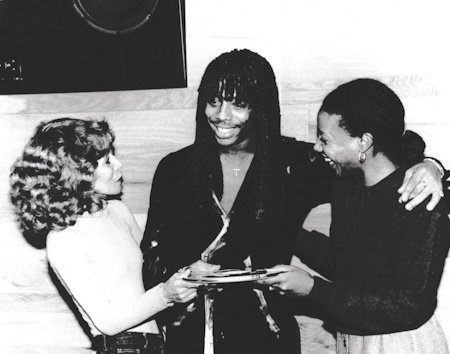
Rick James turns over the tapes for “Standing On The Top” to Motown execs Ray Singleton (left) and Brenda Boyce
Motown’s situation was exacerbated by the previous departure of some of its stars: the Jacksons, Diana Ross, Marvin Gaye and the Four Tops. Ross, in particular, was thriving elsewhere. Her first album for RCA Records turned platinum early in the year, and her concert tours at home and abroad proved highly successful during the summer and autumn, despite the tough business climate.
Michael Jackson, of course, was on the verge of helping to resuscitate the entire record business with Thriller (released at the end of 1982), while Gaye’s future was looking all the better for his new deal with Columbia Records.
And yet…
Motown Records president Jay Lasker, in his second full year in the job, had the benefit of a new star’s popularity – Rick James, whose Street Songs had gone platinum in 1981 and was still selling strongly – and the prospect of solid revenues from the reunion of David Ruffin and Eddie Kendricks with the Temptations, plus the forthcoming solo debut of Lionel Richie.
The Dazz Band broke through early in the new year with strong R&B and pop album sales, while a single which had barely reached the Billboard Hot 100 in 1977 – Charlene’s “I’ve Never Been To Me” – proved to have a second life on both sides of the Atlantic. Meanwhile, Lasker pumped another 60 mid-price catalogue albums (known as midlines) into the American market.
Most important of all was his accomplishment in re-signing Stevie Wonder in the spring of ’82. “I got Berry’s approval to offer $2 million to allow me to pick out songs for a greatest hits album,” Lasker revealed years later. “After much negotiation, he offered me a two-record set for $3 million.”
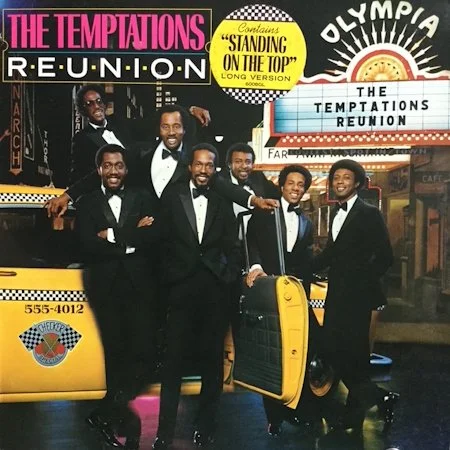
The Temptations: reuniting for a photo shoot, and more
That package, entitled Stevie Wonder’s Original Musiquarium I, included four new tracks, one of which – “That Girl,” issued at the end of 1981 – was peaking high on the charts as Lasker and Wonder’s attorney, Johanan Vigoda, bargained over the re-signing.
The Temptations’ Reunion album didn’t perform as well as anticipated, but the group’s touring take – and their album catalogue sales – were strong, accompanied by considerable media attention. What also helped was the group’s tie-up with Rick James for “Standing On The Top,” and the involvement of the Motown family – literally as well as metaphorically – in the project. Kerry Gordy, one of Berry’s sons, co-wrote two of the album’s songs (and Dad produced them both), while niece Iris Gordy co-produced another. Smokey Robinson was responsible for two tracks, while another was the Temps’ version of “I’ve Never Been To Me,” which was climbing the charts in Charlene’s reissue when their album went to market.
As the year headed towards its end, Lionel Richie’s “Truly” and his solo album gave Motown confidence for the future: Lionel Richie was certified platinum on December 9, and would go on to sell millions more. The record company’s overall profits were $3.7 million – admittedly below 1981’s $6.2 million – but a good outcome, nonetheless, in light of the industry’s wider difficulties.
“Standing On The Top” may be an exaggerated view of Motown ’82, but another of the year’s successful releases (by DeBarge) arguably set the tone: “I Like It.”
Now, to the detail. Below is an effort, selective rather than exhaustive, to convey 1982’s endeavours and progress at Berry Gordy’s business. It’s divided into three sections: the first, a chronological run-down of significant dates during those 12 months, followed by examples of notable single and album releases. If a 45 or album topped the Billboard R&B or pop charts, that entry is shown in bold-face italics. Other Motown timelines can be found here.
MOTOWN 1982
January: Rick James records his new Motown album at the Record Plant’s refurbished Studio B in Sausalito, CA. He previously cut his Street Songs long-player at the facility.
January 15: Stevie Wonder is among those taking part in a march in Washington, D.C. to commemorate the birthdate of Rev. Martin Luther King and to continue the campaign for that to become a federal holiday. In observance, Motown Records is closed today.
January 15: Jr. Walker & the All Stars play a one-hour set at the 1,000-seat Country Club in Reseda, CA, including “Urgent” (on which Walker’s son sings lead), “Shotgun” and “What Does It Take (To Win Your Love).” Also on the bill: Albert King.
January 16: Billboard reports that Stevie Wonder has formed his own label, Wondirection, to be distributed by Motown. Keith and Kevin, sons of the late R&B star, Little Willie John, are said to be its first signings.
January 18: A Los Angeles Superior Court ruling dismisses Motown’s $6 million lawsuit against Bonnie Pointer and producer Jeffrey Bowen, citing lack of evidence. They had been accused of threatening Berry Gordy’s life, among other charges.
January 23: The trade press reveals contenders for the 1981 Grammy awards, as announced by the National Academy of Recording Artists & Sciences (NARAS). Lionel Richie is nominated in three categories for “Endless Love,” including Record of the Year and Song of the Year. He is also up for Producer of the Year. Other Motown nominees are Rick James, Teena Marie and the Commodores.
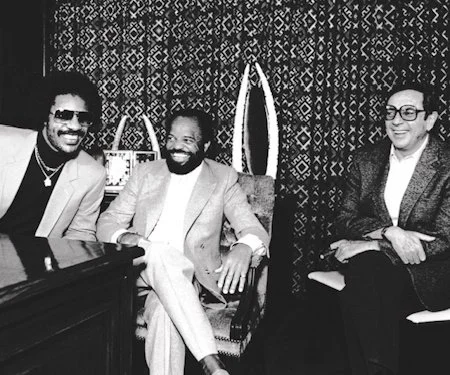
At the Motown HQ on April 6, 1982, Berry Gordy and Jay Lasker greet newly re-signed Stevie with a smile
January 25: Stevie Wonder is presented with the Award of Merit at this year’s American Music Awards. The show is televised by ABC-TV from the Shrine Auditorium in Los Angeles, and he performs “Superstition,” “Sir Duke” and his current single, “That Girl.”
February 20: Berry Gordy’s former second wife, Raynoma Singleton, is reported to have rejoined Motown as VP and operational director for its creative division.
February 24: The Shrine Auditorium in Los Angeles hosts the 1981 Grammy awards, and the show is telecast by CBS-TV. None of Motown’s nominees wins.
March 13: Billboard details Marvin Gaye’s new recording deal with CBS Records’ Columbia label. It is said to earn the singer $600,000 per album. Motown receives $1.5 million from CBS to release Gaye from its contract, plus an override royalty. Later this year, he returns to the U.S. from living in Belgium.
March 22: Motown’s former director of advertising and creative concepts, Tom Schlesinger, dies of a heart attack at age 51 in Detroit. He supervised the company’s graphics, design and album cover art during the early 1970s, working with art director Curtis McNair and illustrator Carl Owens.
March 29: Lionel Richie and Diana Ross perform “Endless Love” during the Academy Awards telecast at the Dorothy Chandler Pavillion, Los Angeles. It is the only time the pair has sung the Oscar-nominated number as a duet, live in person.
April 1: Stevie Wonder signs a new, five-year Motown recording contract. He receives a guaranteed advance of $1.6 million per album, and the company’s highest royalty rate, approximately 35 percent of wholesale. The deal excludes his forthcoming hits package, Stevie Wonder’s Original Musiquarium I.
April 3: “That Girl” climbs to Number One on the Cash Box Top 100 Singles, making it Stevie Wonder’s 12th such triumph on the trade magazine’s pop charts. Two weeks earlier, the single peaked at No. 4 on the Billboard Hot 100.
April 14: The original cast album of Dreamgirls is released by Geffen Records, becoming a major success. The producers of the hit Broadway musical deny it is based on the Supremes. In 1983, the cast album wins a Grammy.
April 24: Smokey Robinson plays the first of two nights at the Greek Theatre in Los Angeles, with Berry Gordy among those in the audience. The singer’s set includes his current solo material and various Miracles hits, including the group’s 1959 debut single, “Bad Girl.”
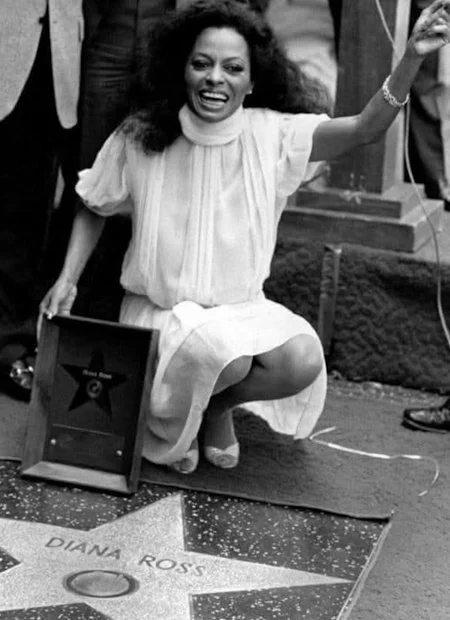
On May 6, 1982, Diana Ross enjoys her moment on the Hollywood Walk of Fame
April 24: Rick James’ Street Songs marks one year on the Billboard album charts, going on to spend another five months there. It peaked at No. 3 in August last year.
April 26: Mary Wilson performs at the Red Parrot nightclub in New York in a benefit concert for the Alvin Ailey Dance Theater. Her 45-minute set includes a medley of Supremes hits and the singer’s first solo single, “Red Hot.”
May: Influential monthly Ebony publishes its annual list of the 100 most influential black Americans, which includes Berry Gordy and Stevie Wonder. The latter is described as an “entertainer/activist.”
May 6: Diana Ross is celebrated with a star on the Hollywood Walk of Fame. Weeks later, respected jazz critic Leonard Feather writes “an open letter” to Ross, seeking her support to have Billie Holiday so honoured (this eventually happens four years later.
May 8: At age 39, Neil Bogart, founder of the Casablanca and Boardwalk labels, dies in Los Angeles. “I was just days from signing a deal [with Bogart] when he died of cancer,” writes Mary Wilson later in her autobiography, Dreamgirl. “In many ways, Neil reminded me of Berry Gordy.”
May 22: Charlene becomes Motown’s first white solo artist to reach the Top 10 of the Billboard Hot 100, peaking on this date at No. 3 with “I’ve Never Been To Me.”
May 22: Martha Reeves plays Toronto’s El Mocambo club, with the Vandellas being Reeves’ sisters, Delphine and Lois. Later in the year, the trio performs a series of dates across the U.K.
May 26: The Temptations’ “Reunion” tour, with David Ruffin and Eddie Kendricks, kicks off a five-night booking at Detroit’s Fisher Theatre, adding two shows per night on May 28-30. Tickets are $10 and $15.
June 2: Diana Ross opens four nights at London’s 9,000-seat Wembley Arena with a two-hour set. The venue has sound problems, prompting Ross onstage to shout at the sound crew. She later apologises. It is part of the star’s first European tour since 1977, with dates in Germany, the Netherlands, Belgium, Norway, Sweden, Denmark and France, as well as the United Kingdom.
June 6: Stevie Wonder takes part in “Peace Sunday: We Have A Dream,” an anti-nuclear rally at the Rose Bowl in Pasadena, CA. Other participating acts include Bob Dylan, Jackson Browne, Linda Ronstadt, Joan Baez and Crosby, Stills & Nash. The sellout show attracts an audience of 66,000.
June 18: Motown releases Diana Ross’ “We Can Never Light That Old Flame Again” as a single, one of three tracks she originally cut with Eddie and Brian Holland in 1978. The record was produced by the brothers with Berry Gordy.
June 24: The Temptations’ reunion tour sells out the Civic Center in Madison, WI – reportedly their first-ever appearance in the city. The 16-piece backup band is directed by Motown longtimer, Gil Askey. According to local press reports, Eddie Kendricks draws the biggest audience response.
June 26: Charlene’s “I’ve Never Been To Me” reaches Number One on the U.K. charts, to become Motown’s most successful single of the year there. The singer appears on BBC-TV’s Top of the Pops.
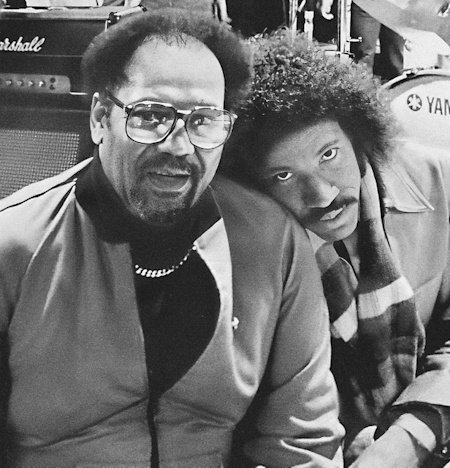
Benny Ashburn, longtime manager of the Commodores, with Lionel Richie
July 4: Diana Ross plays Giants Stadium at the Meadowlands complex in New Jersey, before a crowd of 35,000. “I’ve never done such a large place before,” she says. Frankie Beverly & Maze and Miles Davis are the opening acts.
July 16-18: Rick James’ current nationwide tour sells out three consecutive shows in Jacksonville, Mobile and Augusta. Also in the package’s line-up are the Dazz Band and One Way.
July 17: Motown enters the U.S. Latino market with the release of a Spanish-language album by José Feliciano, Escenas de Amor (Love Scenes). Other acts include Isela Sotelo, whose single, “Angelito,” revives Rosie & the Originals’ 1961 hit, “Angel Baby,” and ranchero singer Pedro Montero. Charlene’s Spanish version of “I’ve Never Been To Me” (“Nunca He Ido A Mi”) has also been released as part of the campaign.
July 19: Rick James’ Throwin’ Down, his follow-up to Street Songs, is certified gold by the Recording Industry Association of America for sales of 500,000 units. It peaks at No. 13 on the Billboard album charts and No. 2 on the R&B listings.
August: Stevie Wonder and the Dazz Band cancel their participation in this month’s ChicagoFest, after civil rights leader Rev. Jesse Jackson calls for a boycott of the event at Chicago’s Navy Pier. This is driven by the appointment of three whites to the city’s housing authority.
August 6: Motown and Jobete Music file suit against Teena Marie for breach of contract, also seeking a restraining order to prevent the singer signing with another record company. At age 20, she originally inked with Motown and its publishing arm in 1976, supposedly without the benefit of outside counsel. Marie countersues Motown and its publishing arm in September.
August 8: Bettye LaVette’s new album earns a half-page splash (above Elton John) in Australia’s Sydney Morning Herald newspaper, complete with an interview with the singer. Motown’s international reach continues.
August 12: Rick James collapses on stage during a concert in Dallas, and is hospitalised for two days. The incident is attributed to stress. The musician resumes his nationwide tour later this month.
August 13: José Feliciano plays the Country Club in Reseda, CA, with fellow Motown Latino artist Isela Sotelo as the opening act. Of his new label affiliation, he says, “I haven’t done a Spanish album in quite a while, so for me it’s a big thrill. It’s a romantic album, very moody.”
August 17: The Commodores’ longtime manager, Benny Ashburn, dies in Englewood, NJ of a heart attack. He was 54. He first connected with the band in 1969. They were initially signed to Atlantic Records, then to Motown. Ashburn’s funeral takes place on August 20 in Harlem.
August 30: Stevie Wonder plays a two-hour set at the Michigan State Fair. It is “a fine show,” according to the Detroit Free Press, with his band “in excellent form.” He closes with his tribute to Rev. Martin Luther King, “Happy Birthday.”
September 4: Motown appoints Steve Barri as VP of creative affairs, according to Cash Box. He reports to president Jay Lasker, for whom he previously worked at ABC/Dunhill Records. Barri replaces Raynoma Singleton, who leaves her VP post at the firm after less than a year.
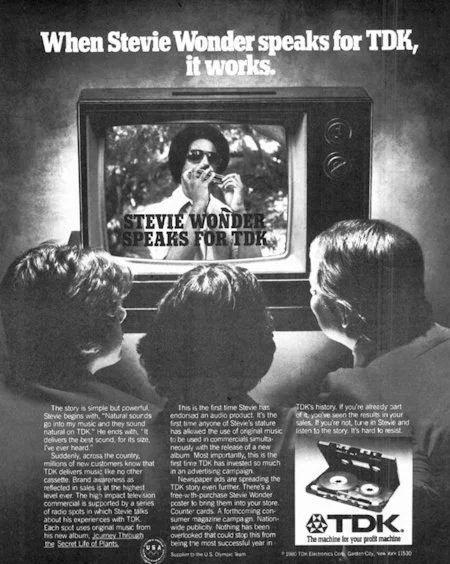
Blank tape: good for Stevie, bad for record sales?
September 4: Jermaine Jackson tells Billboard’s Nelson George that the Jacksons will embark on a reunion tour in 1983, and that he’ll also perform some of his solo material then. His current Motown hit, “Let Me Tickle Your Fancy,” features background vocals by Devo.
October: Rick James informs Associated Press that he’s written a movie script (in his words, “a Cinderella story”) entitled Spice of Life, which is being pitched by his Hollywood manager, Jerry Weintraub, with Motown Productions.
October: Motown is said to have put its Latino subsidiary on hold as a result of the Mexican currency crisis. Division chief Art Brambila has left the company.
October 2: Longtime Motown songwriter Pam Sawyer has set up her own music companies in Los Angeles, according to Billboard. Her first signing is Greg Watson, with whom she wrote and produced “Sureyoureright” by Fantasy act Steptoe. Sawyer left Jobete Music in the past year.
October 2: Diana Ross sells out the Irvine Amphitheatre in California, then has more sellout shows in Inglewood, Seattle, Vancouver, Denver, Rochdale, Buffalo and Pittsburgh, among other cities.
October 28: Stevie Wonder begins a seven-city, ten-concert tour of Japan, including shows in Tokyo (at the Nippon Budokan arena), Osaka and Yokohama. Since 1978, the star has been a spokesman in the U.S. for Japanese tape manufacturer TDK, and it is tying in with his Japanese dates.
November 22: Lionel Richie plays New York’s Carnegie Hall as part of his first concert tour as a solo artist. The 15-city trek of the U.S. began earlier this month.
November 27: “Truly” by Lionel Richie spends the first of two weeks atop the Billboard Hot 100, marking the fifth consecutive year that his songs have achieved that peak. Its predecessors were his duet with Diana Ross, “Endless Love”; Kenny Rogers’ “Lady”; and the Commodores’ “Still” and “Three Times A Lady.”
December 6: Charles (Chuck) Smiley takes on the role of the Commodores’ manager, following the August death of their longtime mentor, Benny Ashburn. Smiley was formerly an ABC-TV vice president.
December 11: Lionel Richie appears on NBC-TV’s Saturday Night Live, performing “You Are” and “Truly” from his debut solo album. Earlier in the month, he said he has no plans to appear or record again with the group.
December 25: A compilation of Diana Ross’ Motown hits, Love Songs, peaks at No. 5 on the U.K. album charts. Marketed under license by TV merchandiser K-tel, it’s her highest-charting release since 1979’s 20 Golden Greats, which was also promoted with television advertising.
SELECTED SINGLES (by release date)
January 15: The Commodores, “Why You Wanna Try Me,” Motown 1604
February 12: The Dazz Band, “Let It Whip,” Motown 1609 (#1 R&B, #5 pop)
February 12: Charlene, “I’ve Never Been To Me,” Motown 1611
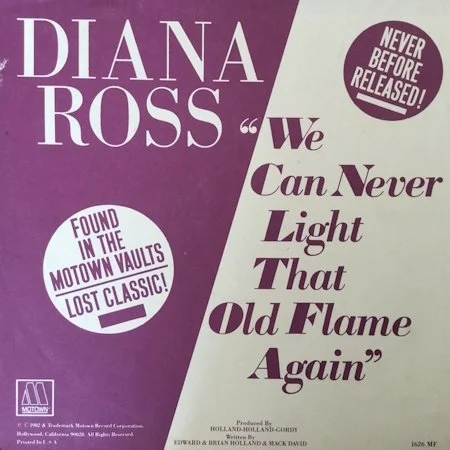
Motown’s missing you, Diana
March 22: Smokey Robinson, “Old Fashioned Love,” Tamla 1615
March 26: Bettye LaVette, “I Can’t Stop,” Motown 1614
March 29: High Inergy, “First Impressions,” Gordy 1613
April 6: The Temptations featuring Rick James, “Standing On The Top – Part 1,” Gordy 1616
April 14: José Feliciano, “I Second That Emotion,” Motown 1618
April 22: Rick James, “Dance Wit’ Me – Part 1,” Gordy 1619
May 19: Stevie Wonder, “Do I Do,” Tamla 1612
May 19: O.C. Smith, “Love Changes,” Motown 1623
June 4: Jean Carn, “If You Don’t Know Me By Now,” Motown 1620
June 18: Diana Ross, “We Can Never Light That Old Flame Again,” Motown 1626
June 18: Ozone, “Li’l Suzy,” Motown 1627
June 18: Smokey Robinson, “Yes, It’s You Lady,” Tamla 1630
July 6: The Dazz Band, “Keep It Live (On The K.I.L.),” Motown 1622
July 6: Jermaine Jackson, “Let Me Tickle Your Fancy,” Motown 1628
July 9: Isela Sotelo, “Angelito,” Motown Latino 1633
August 12: Stevie Wonder, “Ribbon In The Sky,” Tamla 1639
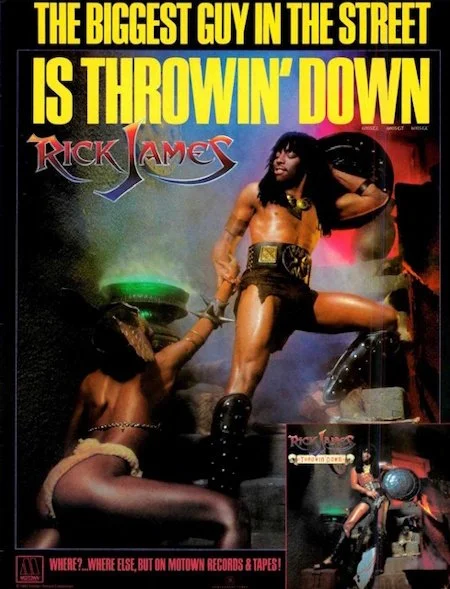
Rick James: where else but on Motown?
August 27: Willie Hutch, “In And Out,” Motown 1637
September 24: Lionel Richie, “Truly,” Motown 1644
September 28: Rick James, “She Blew My Mind (69 Times),” Gordy 1646
October 12: Charlene & Stevie Wonder, “Used To Be,” Motown 1650
October 29: DeBarge, “I Like It,” Gordy 1645
November 5: The Commodores, “Painted Picture,” Motown 1651
December 28: Smokey Robinson, “I’ve Made Love To You A Thousand Times,” Tamla 1655
December 28: Lionel Richie, “You Are,” Motown 1657
December 28: High Inergy, “He’s A Pretender,” Gordy 1662
SELECTED ALBUMS (by release date)
January 18: Bettye LaVette, Tell Me A Lie, Motown 6000
January 27: Smokey Robinson, Yes It’s You Lady, Tamla 6001
February 19: Dazz Band, Keep It Live, Motown 6004 (#1 R&B, #14 pop)
March 12: Charlene, I’ve Never Been To Me, Motown 6009
April 7: The Temptations, Reunion, Gordy 6008
April 16: High Inergy, So Right, Gordy 6006
May 4: Stevie Wonder, Stevie Wonder’s Original Musiquarium I, Tamla 6002 (#1 R&B, #4 pop)
May 13: Rick James, Throwin’ Down, Gordy 6005
May 13: Jean Carn, Trust Me, Motown 6010
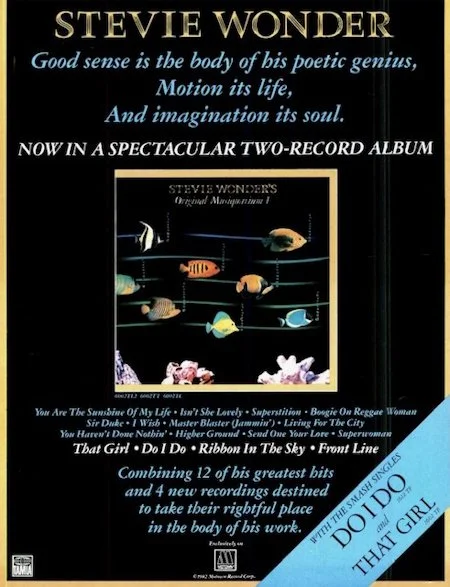
Stevie Wonder: his poetic genius
May 14: O.C. Smith, Love Changes, Motown 6019
July 12: Ozone, Li’l Suzy, Motown 6011
July 12: DeBarge, All This Love, Motown 6012
July 12: Jermaine Jackson, Let Me Tickle Your Fancy, Motown 6017
July 16: Regal Funkharmonic Orchestra, Strung Out On Motown, Motown 6014
July 16: José Feliciano, Escenas de Amor, Motown Latino 6018
August 27: Billy Preston, Pressin’ On, Motown 6020
August 27: Bobby Nunn, Second To Nunn, Motown 6022
September 27: Lionel Richie, Lionel Richie, Motown 6007 (#1 R&B, #3 pop)
October 18: Charlene, Used To Be, Motown 6027
October 19: Bobby M, Rick James Presents Bobby M: Blow, Gordy 6023
November 5: The Commodores, All The Great Hits, Motown 6028
November 5: Bill Cosby, Himself, Motown 6026
November 17: Stephanie Mills, Love Has Lifted Me, Motown 6033
Music notes: it was a very different Motown Sound in 1982 to that made in the Motor City, but not without its charms, as this WGB playlist suggests. The combination of the Temptations and Rick James is attractive, as is Bettye LaVette’s old-skool R&B and Willie Hutch’s disco-oriented groove. And Jermaine Jackson and Devo? Well, just listen.