Maxine Powell: A Teacher of Class
HER ‘MISSION’ SHAPED MANY A MOTOWN CAREER
Among Berry Gordy’s backroom believers, the late Maxine Powell has been documented more than many – albeit that she maintained a tight grip on the extent of her revelations from those Motown years.
In a new book, Powell’s tenure at the company is covered, although most of its lavishly-illustrated 218 pages are about her early career, growing up and working in Chicago during the 1930s, then relocating to Detroit, where she established an influential “finishing and modelling school” during the 1950s.
It was the latter which connected Powell to the Gordy family: sisters Gwen and Loucye took classes there, as did Bertha Gordy. And in 1956, when searching for a printer to handle one of the school’s programme booklets, Powell turned to the Gordy Printing Co., thus becoming acquainted with Esther, who ran the firm with brother Fuller.
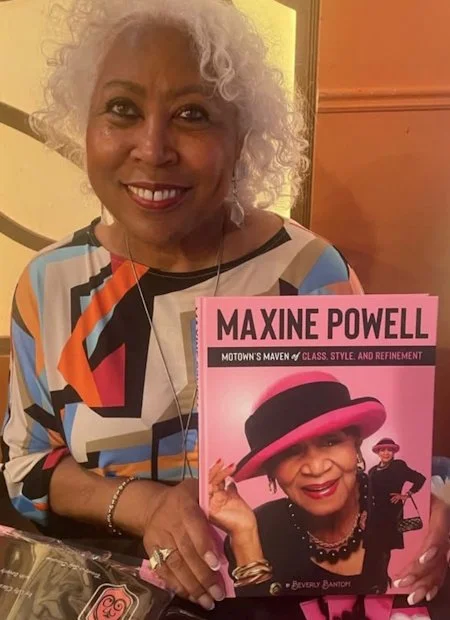
Beverly Bantom honours Motown’s “Miss Manners”
Maxine Powell: Motown’s Maven of Class, Style and Refinement is the book in question, written – and, it appears, self-published – by Beverly Bantom, a Detroit-based entrepreneur whose Unique Expressions is a corporate brand marketing firm and who became a close friend of Powell in her final years.
It’s essentially a coffee-table volume, with scores of photographs from when Powell’s modelling agency was a thriving business in the Motor City. The images are engaging and evocative, among them a striking shot of a young Gwen Gordy when she was one of the so-called “Powell Models.”
The first chapter of Maxine Powell was written by the lady herself, who was born in Texas, taken by her father to Chicago as a baby, and raised by her mother’s aunt. In early adulthood (under her maiden name of Blair), she worked with playwright, producer and acting coach Baron James, appearing in Negro Drama League works such as “The Street Called Easy” and “The Devil Was An Angel.” In 1945, she moved to Detroit after a failed marriage to one Jimmy Powell, whose name she kept after their divorce.
Bantom becomes the book’s author from the second chapter on, save for a mid-section with Powell’s personal profile of three women to whom she was close, including Esther Gordy Edwards.
When, in 1964, Motown’s development and growth surged with the success of the Supremes, Powell – at the urging of Gwen and other family members – signed up to help its artists understand and learn the poise, skills and sophistication required for a long-term career in the entertainment industry. Aside from occasional press mentions, she achieved those goals without external recognition, much as Berry Gordy kept the identities of his musicians out of the public eye during the 1960s.
After leaving Motown in 1969, Powell became an instructor at Detroit’s Wayne County Community College. “We must make every effort to understand people, using tact, patience and tolerance under trying situations,” she declares in Bantom’d book, typical of the lessons she taught at the college. When she retired in 1985 after 14 years there, friends and colleagues hosted a tribute at the city’s renowned Roostertail club. Among the performers were Kim Weston and the Velvelettes.
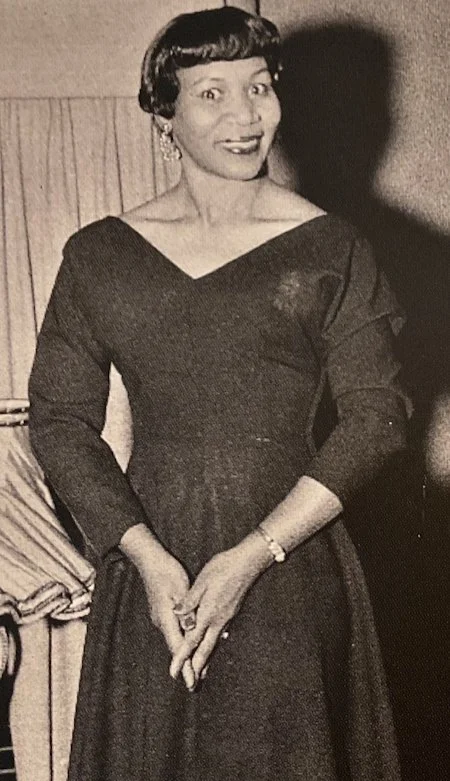
Maxine Powell in her younger years
And then, it seems, Motown’s queen of etiquette felt free to talk publicly about her time with the company. An Associated Press article that August was perhaps the first such interview, in which she told writer Katherine Rizzo, “Now all I have is memories. I don’t have any money. But I have a chapter of contribution in Motown’s history. Even Berry agreed to that.”
Powell also seemed pleased that her work was cited in the then-new Marvin Gaye book by David Ritz. “I’m on page 88. I have almost a whole page devoted to me.” Ritz himself wrote that, privately, she was “embittered” that Motown had not provided for her retirement, though she spoke of her service with quiet pride.
The following year, Nelson George’s Where Did Our Love Go devoted several pages to Powell’s contributions, while popular magazine People profiled her in a piece headlined “Motown’s Own Miss Manners.” Detroit newspapers took up the opportunity, too, including a Sunday edition splash in 2001 (“The Very Image of Grace”) in the Detroit Free Press, while later she was interviewed by Vanity Fair for a major feature about Motown’s “greatest legends – in their own words.” Powell also figured in The Art of Grace: On Moving Well Through Life, a 2015 book by Pulitzer Prize winner Sarah Kaufman.
Such coverage was not limited to the United States. Kingsley Abbott’s U.K.-published Calling Out Around The World: A Motown Reader included a Powell interview (“I believe that I brought class to Motown”). And when she died in 2013 at age 98, there were obituaries abroad (Britain’s Guardian, Independent and Daily Telegraph newspapers, China Post and the BBC) as well as at home (New York Times, Washington Post, Los Angeles Times, USA Today, CNN, Associated Press and more).
When interviewed, Powell tended to recount the same anecdotes and stories of her life with the discipline displayed in how she taught Berry Gordy’s artists to walk, talk and get out of automobiles. That these memories are largely recycled – without more revelations – in Maxine Powell, therefore, is disappointing. Rather than interviewing Motown artists and executives anew, and integrating that into the narrative, Bantom has collected a series of prepared quotes and tributes from Berry Gordy, Diana Ross, Smokey Robinson, Claudette Robinson, Martha Reeves, Paul Riser, Pat Cosby and the late Janie Bradford, among others. Moreover, few of the photographs in this part of Maxine Powell have not been seen before.
In the book’s final chapter, “Me and Maxine,” Beverly Bantom devotes pages to herself, her early acquaintance with Powell, and then their blossoming friendship. In conclusion, she quotes her heroine as saying, “I had a mission…and I filled it.”
With that, at least, no one can argue.
Powell-plus notes: as they say in England, no buses for ages – then two come along at once. But on this occasion, that’s not a complaint. Beverly Bantom’s book will be followed in the spring by a Powell biography by Callista Gould, a Midwest-based, certified etiquette instructor, who also worked in marketing for Sony Music. It will feature first-person interviews and a number of “debunked myths and surprises” about Powell, according to Gould, whose LinkedIn presence includes this tale of another Motown name – on a special mission.