The Control of Quality
‘LET’S ASK THE KID’
No one exemplifies the responsibility and respect that Berry Gordy afforded women in his business more than Billie Jean Brown.
Within a relatively short time of joining Motown, this youngster (in her early twenties, no less) ran the department that was at the centre of its commercial heartbeat, relied on by Gordy for decision-making which helped to shape its output and deliver its hits.
“She was tough and opinionated,” said the company founder, upon learning of her death on July 18, at age 85. “A bright light in the Motown family is gone.”
Brown’s candour was coupled with a deep knowledge of music. “I could always be counted on to give my honest opinion,” she once told author Don Waller. “When a producer would bring a track into Mr. Gordy’s office and there’d be some disagreement, he’d always say, ‘Let’s ask the kid.’ ”
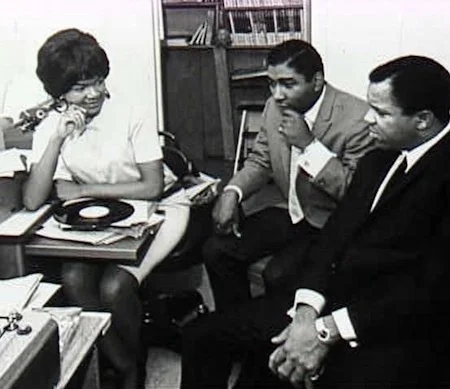
Billie Jean Brown, Brian Holland, Berry Gordy (photo courtesy of West Grand Media)
She was, indeed, a kid, having arrived at Motown part-time in 1960, recruited by Gordy’s sister, Loucye, to write album liner notes (which she did three days a week after school). The teenager was attending Detroit’s Cass Tech High School, where her talent became apparent as editor of the student newspaper.
“During Billie Jean’s first week,” wrote Gordy in his autobiography, “I got a strong dose of her personality when I stopped by Loucye’s office to read over a past-due payment letter being sent out. As I read it, I overheard the new assistant grumble loudly, ‘How are we going to get any work done if everybody keeps hanging out up here?’ ”
Later, Brown worked in a corner of Gordy’s office, which was a converted bedroom, and advanced to write press releases and handle artists’ fan mail. She reminisced about it all for the late Waller, a journalist who secured her only substantial interview more than 40 years ago; it formed an essential part of his book, The Motown Story (Charles Scribner’s Sons, New York, 1985).
In 1961, Brown became full-time at the firm, earning $22 a week as a tape librarian. One day, Gordy noticed her listening to records on a small 45 player, and asked what she thought of them. “She proceeded to go over each song, telling me what she didn’t like about them. She was strong, opinionated, honest, witty and had a good ear. That was good enough for me. I put her in charge of Quality Control.”
In so doing, Gordy replicated his city’s auto manufacturers. As has been well-documented over the years, Motown’s record producers submitted final mixes of their new material in a weekly Friday morning meeting. Attendees – songwriters, producers, sales staff and others – would listen and vote their approval (or otherwise). Music-savvy Brown first vetted the submitted recordings, then lined up the chosen ones for audition. “See, I wasn’t personally involved in [the music],” she said. “And I don’t care who you are. When you’re real close to something, you can’t be totally objective. Also I was young and I didn’t understand some of the role-playing, the political things going on around maybe a certain track. I’d always been brought up to speak my mind. So I did.”
WAITING FOR HER SOLO
The result soon gave Brown one of the most influential roles at Motown. She was “feared by almost every producer in the room,” according to Gordy, “because they knew she ‘had my ear.’ She had as keen a sense for what was a hit as anyone I knew. And she knew it. That’s when she sat there like a diva in the last act waiting for her solo.”
Years ago, when I asked Gordy about the effect on the company’s creative team of the rejection implicit in the QC sessions, he said, “ ‘Rejection’ may be a slight exaggeration, because most of the records that didn’t make it were because of votes at the meeting. That was rejection in a sense, but it was rejection by the peers of people who were doing it. And sometimes by themselves.
“When they heard records in an open forum, they could see imperfections and a lot of things they couldn’t see by listening to [a record] by themselves. That’s as far as the meetings were concerned.”
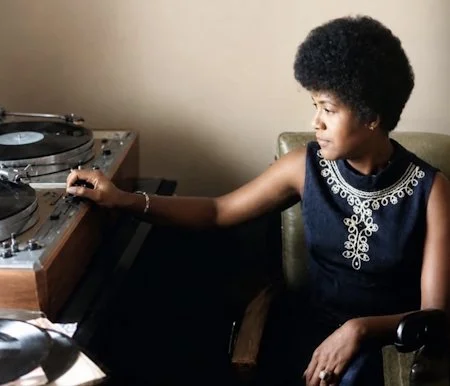
‘When you gonna play my song, Billie Jean?’
“It was essential that the records were auditioned in the Quality Control meetings by acetate, not tape,” remembered Barney Ales, Motown’s sales supremo during the 1960s. The Friday sessions were not held at 2648 West Grand, said Ales, “but in the building next door, where Berry had his office.” As far as albums were concerned, he said the practice was for him to give Brown a date for a projected release, “then Billie Jean would put it together, whether it was a ‘greatest hits’ or whatever.”
The pressure on Brown from Motown’s creatives became more intense as the company expanded. “It got so bad,” she told Waller, “with producers and songwriters and artists and everybody interrupting me, ‘When you gonna play my song? When you gonna play my song?’ that I finally put a picture of an ear on my door with a note saying, ‘If you want to hear your song, place your ear here.’ But you know Stevie Wonder never paid attention.”
As Motown grew, Gordy spent more time away from Detroit – and from the Quality Control meetings. At first, he would ask to hear new releases by telephone; then, he became too busy for even that, depending instead on his executive team. For example, Ales said that he and Brown mulled over the release of Marvin Gaye’s “What’s Going On” in the absence of any other new material by the singer. “Billie Jean and I listened again to the track and decided to release it as it was. When we got out to California, I remember Berry called me in and said, ‘How could you release that record? It’s the worst I ever heard.”
Ales also chuckled over another anecdote, when during one Detroit winter, he, Brown and sales director Phil Jones went out to lunch near Motown’s Woodward Avenue HQ. “Billie Jean was smoking at the time, and her hair caught on fire. Phil had one of those blue coats, cashmere, that she put over her head to stop it from burning. It was so cold, but if he hadn’t taken off his coat…”
A LOYAL DETROITER
Brown had her own creative streak, co-writing Martha Reeves & the Vandellas’ “I Promise To Wait My Love” and (with Shorty Long and Suzanne de Passe) “Here Comes The Judge.” Also, “Favor For A Girl With A Love Sick Heart,” penned with Clarence Paul, and recorded by Brenda Holloway.
Motown’s QC queen moved to California when the company did in the early 1970s. She continued working there (including a spell in the so-called “special markets” division) until 1979, when she quit and trained to become an attorney. Brown was admitted to the state bar of California in 1983, and practiced law thereafter.
“Billie Jean was very special to me,” Gordy declared in his tribute to Brown this week. “She was one of those loyal Detroiters who followed me down roads that didn’t even exist, including the journey that brought us to California.” Her loyalty and contributions will always be remembered, he added, “and she will always hold a special place in the Motown family.”
Especially every Friday morning in Hitsville heaven…