The Queen of Golden World
A MOTOWN COMPETITOR — AND FINES FOR THE FUNKS
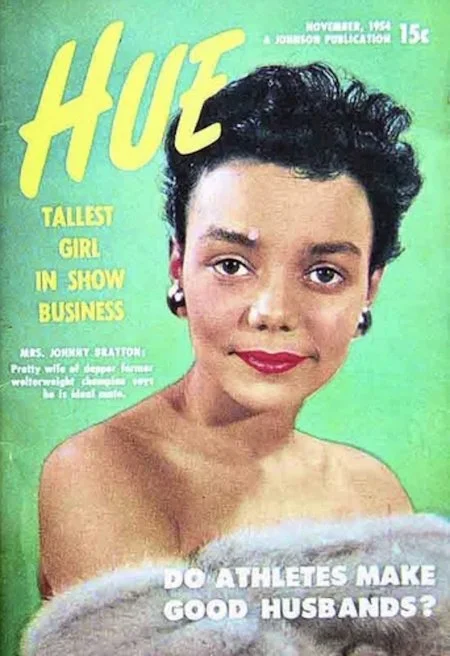
Early on, Joanne Jackson discovered the delights and demands of a life lived in public. At age 24, she was featured on the front cover of celebrity magazine Hue as the “tallest girl in showbusiness.”
At the time, Jackson was also the “pretty wife of dapper former welterweight champion” Johnny Bratton, according to Hue. His boxing success in the 1940s and ’50s meant that the couple – who had met as teenagers – were often in the public eye. “Johnny was a ‘somebody’ and I loved the glory and all the good things in life that came with it,” Jackson later told the Detroit Free Press. In subsequent years, she became a lower-profile but influential figure in the Motor City’s music industry – and something of a heroine on the other side of the Atlantic.
The reason for these recollections? Her death earlier this month, on July 5; she was 96, and her funeral was held in Detroit this past Monday (13).
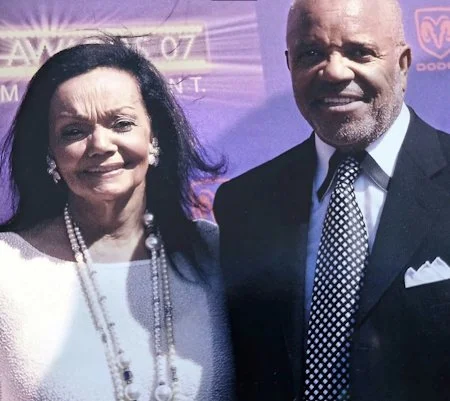
Joanne Jackson and Berry Gordy
But first, those looks. “Joanne was one of the most beautiful girls to grow up on the Westside,” wrote Berry Gordy in his autobiography. “I had a big crush on her when I was around five or six, but she was about the same age, which made me mentally too young.” He was hardly the only music man to be so attracted. “Joanne…was the foxiest chick I had seen in a long while,” recalled singer/songwriter Al Kent in his own memoir, Custodians of the Hummingbird.
Both men had good reason to know Jackson. She and business partner Ed Wingate launched and successfully operated the Golden World and Ric-Tic labels in Detroit during the 1960s. At the beginning of that decade, Gordy even approached Wingate – who was also a major figure in the city’s numbers business – to invest in Motown. “He was looking for some additional funding,” Jackson explained to David Meikle, co-founder of the long-running SoulfulDetroit website. “He asked Ed if he would like to become a partner.
“However, my own advice to Ed was to forget it. They both had extremely powerful personalities, and I just could not see it working out. To this day, we have no regrets on that front.”
Still, Jackson admired Gordy’s business. “I credit him with getting me started,” she explained in 1965. “He graciously showed me every inch of his studio, explaining the workings of everything, and then warned me that the record business is tough. But he did encourage me to try it.”
In addition, Jackson and Wingate went to New York to meet George Schiffer, who was then an independent New York-based attorney with Gordy among his clients. “George…had helped to establish Motown on a firm footing,” Jackson told Meikle, “and it seemed like a good idea to ask for his assistance. He was expert in drawing up contracts on anything to do with the music business. He was very frank with us and warned us of the high mortality rate that existed in that field. He also pointed out that we were at a disadvantage to Berry because he was able to write his own material, whereas we were not. We both admitted that we couldn’t write a thing.”
PROUDLY ANNOUNCING A HIT
Jackson continued, “It was obvious, too, that Schiffer felt there would be a conflict of interest between representing two rival record companies in the same town. We respected that and eventually found another lawyer with similar credentials.”
Wingate and Jackson launched Golden World Records in the opening weeks of 1962 with a single, “I Wonder,” by Sue Perrin. “There’s a country feel to this catchy teen-romantic cut from the lark and her combo-femme chorus accompaniment,” ran the Cash Box review at the time. It was not a hit, nor were subsequent 45s by Leroy Small, Joyce Webb and the Adorables, among others.
Success arrived in ’64 with “(Just Like) Romeo And Juliet” by white Detroit pop quintet, the Reflections, a substantial hit on the Top 100 charts of both Billboard and Cash Box. “Golden World Records proudly announces the first (of many) Top Ten records,” declared the firm optimistically in a full-page Billboard advertisement in May that year. The ad identified premises on Detroit’s Buena Vista Street, although most of the label’s initial releases were recorded in New York or Chicago.
In 1965, with Jackson billed as Golden World’s president, the business moved into new premises on West Davison, and installed a recording studio with engineer Bob D’Orleans. “Ed, because of visiting Berry and doing some other research, had uncovered that one of the vital ingredients of a recording was an echo chamber,” Jackson told Meikle. “It apparently gave you the sound that you wanted. However, we didn’t know what sound we wanted, we just knew that we didn’t want the Motown Sound. We just didn’t know how complex the design and building of a studio could be.”
Golden World’s eventual self-sufficiency in that respect – which did mirror Motown – began attracting talented local music makers, including several who had previously worked for Gordy’s operation, such as Sonny Sanders, Richard “Popcorn” Wylie, Freddie Gorman, Andre Williams and George Clinton. “I learned every aspect of the business [there],” wrote Clinton in his memoir, “from writing and arranging to how to oversee recording sessions to getting the records out to local radio stations.”
The narrative after that is familiar: how Golden World and sister label Ric-Tic signed and broke a number of acts, among them Edwin Starr (“Agent Double-O-Soul” and “Stop Her On Sight,” Top 10 R&B hits, both), J.J. Barnes (“Real Humdinger”), the Holidays (“I’ll Love You Forever,” also Top 10 R&B) and, improbably, the San Remo Golden Strings (their “Hungry For Love” went Top 30 pop). “Ed Wingate’s money was like running water, but Joanne Bratton was the faucet that turned it on,” declared Al Kent, who wrote and produced for the firm.
This success extended across the ocean, too. Starr’s “Stop Her On Sight (S.O.S.)” and “Headline News” made the Top 40 during 1965-66 in the U.K. – and when coupled as a reissue two years later, the single stopped only one spot short of the Top 10. The singer capitalised on this, regularly touring British clubs and developing a large, loyal following there which endured for decades.
The competition got noticed at Hitsville U.S.A., of course – not least because members of Gordy’s in-house band were moonlighting at Golden World’s West Davison studio. (When caught and fined by Motown for doing so, the musicians reputedly had those penalties covered by Wingate, in cash.)
FRIENDSHIP OVER RIVALRY
“Joanne grew into a smart, kind and funny woman – and a very shrewd businesswoman,” said Berry Gordy in tribute just a couple of days ago. “Their companies became some of Motown’s strongest local competition, but our friendship was always more important than any business rivalry.”
Even so, Gordy was sufficiently concerned at the time that he bought out Golden World during the second half of ’66, including its studio (which became Motown’s so-called Studio B), its recording masters, music publishing assets and the artist contracts of Edwin Starr and J.J. Barnes. The rumoured price was $1 million, considered high in some quarters.
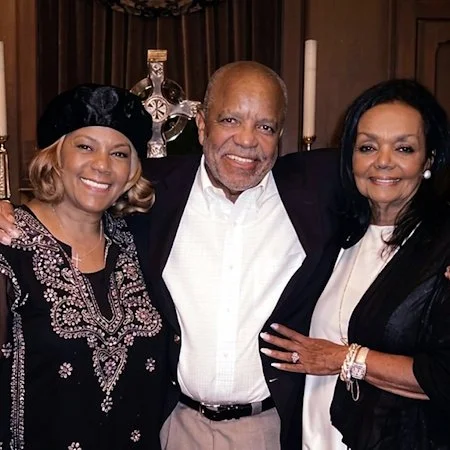
Jackson, Gordy with Claudette Robinson
“Don’t forget that the property there was a good piece of land,” former Motown executive Barney Ales told me some years ago, “and all the stuff in the studio. Just the property would have been worth $200,000.” He put the real price “between half a million and $700,000. Everyone exaggerates.”
For Ed Wingate, that might have been chump change. In addition to his considerable stature and influence in Detroit running illegal lotteries (“the numbers”), he had ownership stakes in the 20 Grand Motel, taxi firm City Cab and a restaurant. “Back in the ’60s, he was already a millionaire,” said Bridgett Davis, daughter of Fannie Davis, another numbers runner for whom Wingate was a banker. “And he was an incredible figure because he, first of all, was notorious. He was really ruthless. And if he liked you, he was good to you. And if he didn’t, you needed to get out of his way.”
For her part, Joanne Jackson had other interests, too. She began acquiring and racing thoroughbred horses circa 1965, and continued doing so for many years. “She was at the track all the time,” said Ales. “She could tell you who was the stud for every horse that was running in Detroit.” Jackson had her own box at the Hazel Park racecourse, he added. “She was always drinking in the dining room area, too, she had a table there.” Like others, Ales remembered her fondly. “Joanne was very, very attractive – and very, very nice.”
Even when she retired, Jackson maintained links with Berry Gordy, helping Esther Edwards to run the Motown Museum during its early years. Later, she married Ed Wingate, and retired with him to Las Vegas. (Wingate died in 2006.)
“Throughout the years, we remained close,” Gordy said of Jackson, “seeing each other at events and sharing many wonderful times. I will especially miss the greetings cards she faithfully sent me, sometimes nearly every week. They did not have to mark a birthday or a holiday. They were simply Joanne’s way of checking in, letting me know she was thinking of me, and making sure I knew she cared.
“Joanne held a special place in my life, and I will miss her deeply.”
Northern notes: after Motown’s acquisition of Golden World in 1966, Ric-Tic continued in operation, scoring R&B and crossover hits in the U.S. with the likes of the Fantastic Four, Al Kent and the Detroit Emeralds. Berry Gordy bought the label in 1968. Towards the end of that decade and into the ’70s, the output of both imprints got a new lease of life via Britain’s Northern Soul scene, with their records perpetually being spun in clubs across that part of the country, and commanding high prices when sold. Which is how it was that Joanne Jackson was known and admired thousands of miles from Detroit. A real humdinger, you might say.