A Pair of Pre-Motown Adventures
BEFORE RICK JAMES AND RARE EARTH DELIVERED THE HITS
The reviews did them no favours at all.
“A certain number of sock-it-to-me-I’ve-got-it-together crusade cliches are, if not welcome, at least acceptable in the rhythm & blues vernacular. But with White Cane, that’s all there was, other than a lame horn section, a self-indulgent guitarist, a monotonous keyboard man, and a confused set of bass lines.”
That was Brian McLeod in the Vancouver Sun. Then there was Peter Goddard in the Toronto Star: “White Cane, from Toronto, seemed overflowing with talent but somehow couldn’t focus it enough to come up with a decent song.” The Salt Lake Tribune’s David Proctor observed: “The crowd went mildly bananas over White Cane and their rather untalented gyrations, which amazed me no end.”
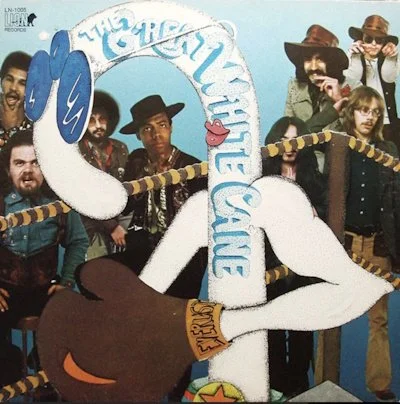
The Great White Cane (cool hat, Rick)
Finally, Jeani Read at The Province in Vancouver judged the act to be “spewing nothing more than a remarkable amount of energy, general weirdness and compactly busy sound very forcefully over the audience.”
It was the summer of 1972, and the Great White Cane (as they were originally billed) were opening for B.B. King during his latest transcontinental tour of the U.S. and Canada – hence, the reviews. Just a couple of months earlier, MGM Records had shipped The Great White Cane to its wholesale and retail customers. This was the group’s debut album (with a gatefold sleeve, no less) on MGM’s Lion label, and although it didn’t earn much ink in the trade press, Billboard called it “an adventurous blending of various elements of jazz and Latin music.”
Which are hardly the flavours usually associated with one of Motown’s biggest-selling artists of the 1980s: Rick James.
Yet the eight-man Great White Cane was one of James’ early musical incarnations, and an intriguing showcase for his developing talents. He was involved with writing and arranging the entire album, and sang lead vocals; he also co-produced it with Jimmy Ienner (best-known then for his rock-oriented work with the Raspberries) and engineer Tony Reale. The vibe was one of Blood, Sweat & Tears and Chicago, both of which were enjoying Top 10 albums, while offering James’ own variation on that sound, as well as indicating his ambition.
At the time, Lion was one of several MGM subsidiaries – as was Verve Records, the label which released the debut album by another act later known for its success with Motown: Rare Earth. But more about them in a moment.
‘NO SONGS PROMOTING DRUGS’
Firstly, the Great White Cane. “I wanted a big band,” declared Rick James in his 2014 autobiography, Glow. “I wanted to paint on a large canvas. To realize the sounds in my head, I needed lots of players.” He knew plenty of them, not least from his years in Toronto, one of North America’s more musically-abundant cities. There, James had belonged to the Mynah Birds, whose other members included Bruce Palmer (later of Buffalo Springfield) and Neil Young (later of Crosby, Stills, Nash & Young, etc.). The Mynahs were under contract to Motown in 1966; later in the decade, James also served as one of the firm’s workaday songwriters.
It was during the spring of ’72 that The Great White Cane was recorded at Village Recorders, Los Angeles, and released mid-summer by Lion. MGM’s president was Mike Curb, then basking in the company’s considerable success with the Osmonds. James subsequently claimed that the executive wasn’t happy about his band’s name, but came to accept it. “White Cane is okay,” Curb is quoted as saying in Glow, “long as you have no songs promoting drugs.”

The Sunliners, with Terrana twins Russ (second right, standing) and Ralph (first right, standing)
Lion set about promoting the music, with album rock outlet WBRU-FM in Providence, Rhode Island – the first U.S. student owned-and-operated college station – being an early supporter. The record company also opened a Detroit branch office, with Al Valente, Motown’s former national promotion director, on the team.
Touring with B.B. King helped, too. “Yet for all the goodwill between B’s band and mine,” wrote James later, “for all the excitement of our live tour, the record itself bombed big-time.” He added, “When it was over, I was left with nothing. Curb dropped us, White Cane disbanded, and I was broke.”
Rare Earth’s association with MGM Records and its Verve label appears to have been a more positive experience than Rick’s – and earned plaudits from at least one Motor City critic: “a better than average rock group,” wrote Bob Talbert in the Detroit Free Press about their 1968 album, Dreams/Answers, “and some of the effects are out of sight.”
By this point, MGM had taken Verve a considerable distance from its origins as a jazz label, founded 12 years before by Norman Granz to become the recording home of Oscar Peterson, Billie Holiday and Ella Fitzgerald, among others. The brand was bought in 1960 by MGM, which broadened its repertoire to include the likes of the Righteous Brothers, the Mothers of Invention, Velvet Underground and Howard Tate.
(In 1967, MGM also invested in a new label, Venture Records, the project of former Motown A&R chief, Mickey Stevenson. His wife, Kim Weston, was on the roster, as were a number of other R&B artists, none particularly successful. The joint venture had been negotiated by influential artist manager Clarence Avant. Earlier, Avant signed another of his clients, organist Jimmy Smith, to Verve.)
‘FROM ELVIS TO JOHNNY MATHIS’
Rare Earth had evolved out of a popular Detroit band, the Sunliners, who played the city’s club circuit for years during the 1960s. “We learned a lot of Top 40 hits, pop and R&B performers alike, because that was the hot music of the time,” recalled drummer Pete Rivera in his autobiography, Born To Wander. “I sang everybody from Elvis to Johnny Mathis.”
Other longtime members of the Sunliners were the Terrana brothers, Ralph (on keyboards) and Russ (guitar). When they quit the group circa 1966, Ralph bought and operated what became the Tera Shirma recording studios in Detroit, while Russ worked as an audio engineer at Motown. The remaining Sunliners recorded tracks with local producers Dennis Coffey (also a frequent session guitarist at Motown) and Mike Theodore, who placed them with MGM Records via Clarence Avant. One single for the label was 1967’s “Land Of Nod.”
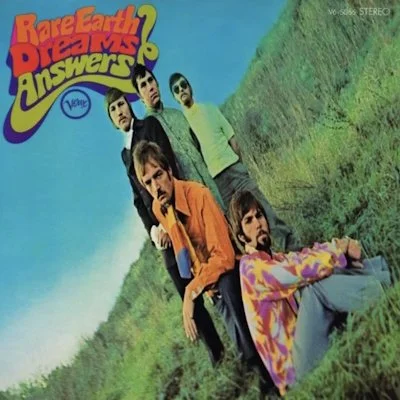
Reborn as Rare Earth, gettin’ ready for success
When the Sunliners chose to rename the band as Rare Earth, Coffey and Theodore produced the Dreams/Answers album and – once again, using Avant’s influence – obtained its release on Verve. The sessions took place in late September 1968 at (where else?) Tera Shirma, by which time Rare Earth’s line-up comprised Pete Rivera, Kenny James, Gil Bridges, Rod Richards and John Parrish.
Dreams/Answers included songs written by Theodore, Coffey and Parrish, plus the group’s remakes of Wilson Pickett’s “634-5789,” the Coasters’ “Searchin’” and several Jobete copyrights. Indeed, the first 45 release was “Stop/Where Did Our Love Go,” which earned an R&B chart tip in Billboard, but didn’t register. The other cover was “Get Ready,” which – when re-recorded on their Motown album debut the following year – delivered the goods: a Top 5 smash on the Billboard and Cash Box pop charts in June 1970.
In retrospect, it’s clear that, talent aside, both Rick James and Rare Earth were lucky in their careers. The latter’s good fortune derived from a hairdresser. The band’s manager, Ron Strasner, had a business partner who owned a Detroit salon patronised by Margaret Norton, mother of Berry Gordy’s son, Kennedy. She saw the band and, in turn, enthused about them to senior Motown executive Barney Ales. “Margaret was the one,” he once told me. “She was always saying, ‘You gotta see this group.’ ” When Ales did, he was impressed enough to recruit them for Motown’s upcoming rock label – soon to be named Rare Earth.
Rick James’ luck came from his earlier Motown connections. Pitching music to record companies in Los Angeles in 1977, he bumped into writer/producer Jeffrey Bowen, who remembered him from the Mynah Birds. This – and, more importantly, the calibre of James’ new music – landed him the second shot at success with Hitsville U.S.A..
Evidently, those Great White Cane reviews proved to be no obstacle.
Music notes: once upon a time, both the Rare Earth and White Cane albums were only available in their original vinyl form (and 8-track?). Then in 2017, Culture Factory/Universal Music reissued Dreams/Answers on high-definition CD. Today, both that album and – remarkably – The Great White Cane can be streamed on digital music services. Now you can make your own judgement…