Dazzling and Dandy in London
THE TEMPTATIONS HIT TOWN, AND GET TALKED ABOUT
“The Temptations stood England on its ear during the two weeks the five attractive Detroit lads headlined the Talk of the Town club before SRO crowds.”
So claimed an American newspaper, 56 years ago this month. Local reviewers were less inclined to such exaggeration, at least on that occasion. “One man short in their line-up, the remaining four of the all-singing, all-dancing male vocal group gave what I judged to be a fascinating illustration of that rather old-fashioned stagecraft that distinguishes performances by the many all-coloured acts allied to the Detroit-based Tamla Motown recording complex,” wrote Ray Connolly in London’s Evening Standard on January 13, 1970.
“They clapped heartily at the beginning of every number,” offered Tony Palmer in The Observer about the nightclub’s audience, “long before anyone had a chance to recognise what song it was. They banged the table encouragingly at every balletic gesture of this military-trained group. When [Dennis] Edwards parts the sea with his hands, they all part the sea with their hands. When Edwards tosses his head, they all do it.”
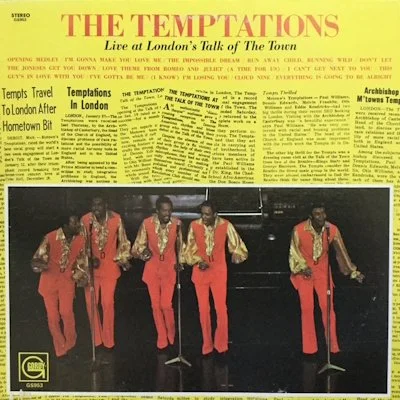
‘Five attractive Detroit lads’
Billboard focused on other issues, as befits a trade paper, with reviewer Brian Mulligan describing “the restaurant’s amplification system at its most maddening, which rendered much of the group’s performance unintelligible, so badly was the sound balanced.”
What few, if any, journalists noted was the fact that the Temptations’ two-week residency (from January 12) at the Talk of the Town marked the first time the Motown hitmakers had performed in front of paying audiences in Britain.
Maybe that wasn’t surprising. Despite the high calibre and consistency of the quintet’s 1960s output, they scored no U.K. Top 10 hits whatsoever until 1969 – and one of those (“I’m Gonna Make You Love Me”) was arguably lifted by their partners-in-song: Diana Ross & the Supremes. The Temptations’ other British hit that year? A reissue of three-year-old “Get Ready.”
To be fair, the quintet enjoyed three consecutive Top 20 albums (Greatest Hits, Temptations Live!, With A Lot O’ Soul) in the U.K. in 1967 – no mean feat, given the absence of major single successes. But based on the scale of the Temps’ hitmaking at home – ten Top 10 singles on the Billboard Hot 100 from 1965-69, four of them consecutive, and six Top 10 albums, plus the chart-topping T.C.B. with Ross & the Supremes – perhaps it was logical and profitable for Motown to keep them on home soil, performing for tens of thousands of Americans every year.
The Temptations had set foot on the British Isles in 1965, recording their part in The Sound of Motown television special and undertaking other TV (and radio) appearances, including Thank Your Lucky Stars and Top Gear. But none of these were for the benefit of paying audiences, and the single they promoted on that trip (“It’s Growing”) spent a mere two weeks on the U.K. best-sellers, peaking at No. 45.
Still, the opportunity to perform at London’s leading nightclub at the dawn of 1970 apparently seemed attractive. Moreover, Ross & the Supremes’ stint at the Talk of the Town in 1968 was a triumph, not only delivering bounty at the box-office but also a Top 10 live album. And so Motown’s man in the U.K., John Marshall, got down to the task of organising a similar project for the Temptations.
FIRST ATTEMPT ABANDONED
“It will be important that the tune line-up on the live album will be as commercial as possible,” wrote Marshall to Phil Jones in Detroit, who oversaw Motown’s international activities at that point. “Therefore, I consider that the group’s next single, if available, be included in the act.
“The costs of the recording,” Marshall continued, “I anticipate to exceed, but not by a large amount, those incurred by Diana Ross and the Supremes’ Talk of the Town album. Certainly, the total cost should not be above $4,500.” (By current measure, around $37,500.)
According to Marshall today, “the first attempt to record the live album was abandoned – I think for technical reasons.” Alternatively, Eddie Kendricks’ failure to arrive with the rest of the Temptations may have been the cause. He was said to be suffering from flu, but relations between him and the rest of the group were not good. A couple of days later, Kendricks crossed the Atlantic and joined them on stage.
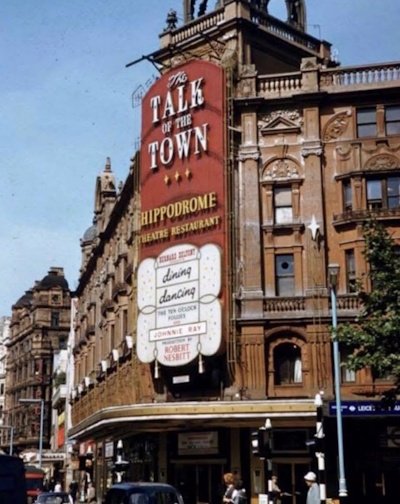
London’s premier nightspot, back in the day
Subsequently, the Temptations’ show was committed to tape, on January 16 and 17 (Kendricks was present by then). What the Talk of the Town paid Motown’s International Talent Management Inc. to book the group is lost to time, but one aspect of the set-up is known. The local musicians backing them were Bert Rhodes & His Orchestra, and for the recording, they were paid £381 (around £7,500 today). What the paperwork identifies as “four extra musicians” earned £135 (£2,500), but it’s not clear whether or not these were the Temps’ own rhythm section from Detroit. Those imported players were Stacy Edwards on congas, Melvin Brown on drums, Bill White on bass, and Cornelius Grant on lead guitar – Grant, of course, also being the Temptations’ longtime musical director. In the Billboard review of the show, he was described as “a tower of strength.”
Norman Smith was recruited to produce and engineer the recording, although this was uncredited on the U.S. album release; he had been associated with EMI for years, and worked with the Beatles, among others. He had also produced the Pretty Things’ 1969 album, S.F. Sorrow, which Motown acquired as one of the first releases on its Rare Earth rock label. Later in 1970, Smith was to produce Stevie Wonder’s ‘Live’ at the Talk Of The Town long-player.
In his autobiography, Temptations, Otis Williams recalled the group’s London visit in ’70, writing that “during our stay [we] hung out with many celebrities, including the Beatles and Nancy Wilson.” He offered no detail of the Talk of the Town experience, preferring to remember how “a famous actress” – unidentified in the book – came on to him blatantly, and how he declined the opportunity, not least because he was happily married at the time.
“EMI will be rush-releasing the album as soon as possible,” John Marshall observed in his note to Phil Jones, and Junius Griffin, Motown’s publicist in Detroit, “should be asked” to draft a press release about it promptly.
In the event, the Temptations’ Live at London’s Talk of The Town was issued in April in the U.K. (where it did not chart) and three months later in the U.S., where it peaked at No. 21 on the main Billboard LPs chart and at No. 5 on the R&B best-sellers.
“There is no question about their skill at making show,” opined Tony Palmer in The Observer, “nor about their musical accomplishment. They sing complex five-part harmony as easily as if it were unison, whilst at the same time prancing around the stage as if they were an old-time formation dance team rehearsing in the nursery.”
Their turn at the Talk of the Town, he concluded, was “like a skinhead’s pantomime, dazzling and dandy.” For praise like that, perhaps it was worth waiting.
Music notes: the Temptations’ Live at London’s Talk of The Town can be found on digital streaming services. It also appears to be one of their few albums which wasn’t reissued on compact disc. Temptations Live! came out on CD in 1999, and in the same format, Universal Music’s Hip-O Select in 2004 released In Japan, featuring the recording of a 1973 Tokyo concert. Five years earlier, the group had performed three shows in the Japanese capital with Stevie Wonder and Martha Reeves & the Vandellas in a package dubbed “The Sound of Young ’68” [sic]. The promotional leaflet included a phonetic misspelling of Otis Williams’ first name: “Autis.”
Return notes: the Temptations came back to Britain two years after their Talk of the Town run, seemingly more popular than ever. At the close of their show that April at London’s Hammersmith Odeon, a local newspaper reviewer reported that “young fans who had already given the Temptations a standing ovation stormed the stage and their chanting for more was still going on as the National Anthem was being played.” Bless.