‘Superstition’ and an IQ of 140
’YOU’RE NOT COMING OUT OF THIS ROOM UNTIL…’
There surely can’t be anything new to learn about “Superstition,” although one or two questions remain. Who, for instance, was Katie?
It was the spring of 1972, and Stevie Wonder was working with producers Malcolm Cecil and Bob Margouleff on material for his next album, to follow Music Of My Mind. “I had come over to London with Stevie and Gene Kee to do some string tracks,” Cecil told me for The Billboard Book of Number One Rhythm & Blues Hits. “I wanted to use British strings, because the strings sound different in the States. I had booked all my old buddies from the BBC Radio Orchestra, and we went over to AIR Studios and recorded there.
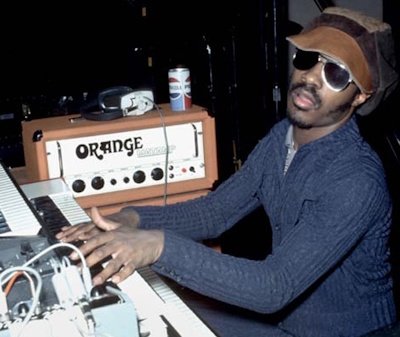
‘We gotta have the words, Stevie’
“In the evening, after [the players] had all gone, we stayed in the studio. Then came the parade, one at a time. Jeff Beck came over, Eric Clapton, ‘Fuzzy’ Samuels. One after the other. Obviously the word went around: ‘Stevie is in town, and he is receiving.’ Everybody came over to play and to talk and to have fun.”
A friendship developed between Wonder and Beck, in particular, and the British guitarist became keen to record “Maybe Your Baby,” one of the Motown star’s newer compositions at the time. But Wonder – in a tale now burned into rock history – decided he wanted to keep it for himself, and offered Beck “Superstition” instead, even though its lyrics did not yet exist.
By that point, everyone concerned was gathered in New York’s Electric Lady studios. Cecil recalled, “We said to Stevie, ‘We gotta have the words to ‘Superstition.’ Jeff is going back to London tonight. It’s the last chance [to do this] for three or four months, he’s going to be on tour.
“So eventually I get Katie, who is a very good friend. She is a very good shorthand typist, very literate and an IQ of 140. So I shut Stevie in this room with Katie, and I said [to him], ‘You’re not coming out of this room until we have the lyrics.’ And I locked them in.
DID MOTOWN STILL HAVE CONTROL?
“Stevie knew the song, so Katie was there taking down notes and stuff. He was trying to come up with things, and she was trying to write them down. I think basically he sang bits of it. We figured that eventually we would get some things out of it. So that is how the lyrics of ‘Superstition’ got written. Then we went in [to the studio] that night and recorded the vocal with Jeff.” (Now if only the history books had Katie’s first-hand account.)
The tale did not end there, of course. It subsequently emerged that Wonder decided to keep “Superstition” for himself, its hit potential being too strong. Or was it Motown which believed that, and determined the final outcome? “It was the first inkling I had that [Wonder] was not being entirely truthful…that, in fact, the label still had control,” said Cecil, quoted in the recently-published Buzz Me In, an account of the Record Plant recording studio in Los Angeles where he, Margouleff and Wonder frequently worked.
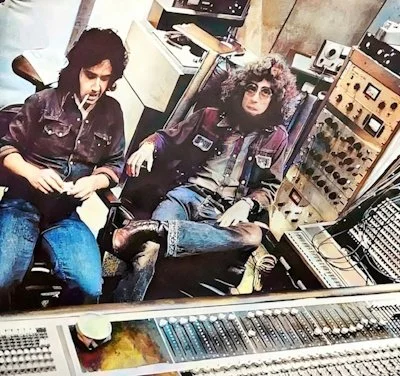
The Wonder team: Bob Margouleff (l) and Malcolm Cecil
So “Superstition” came into being at studios on both coasts, along with many other songs of Wonder put on tape that spring: “It Would Break My Heart In Two,” “God Is Freedom,” “Our Love Is A Thing Of The Past, “Sound Of Her Voice” and “Life Is Tragic” among them, according to session records. (None of those five were ever released – or completed? – as such, although they might have mutated into other works.)
Before Motown sent “Superstition” to market in October 1972, Wonder introduced the song that summer during his career-changing U.S. tour with the Rolling Stones. He also sang it during a five-night stint at Los Angeles’ Whisky a Go Go in early September.
It’s still in his concert repertoire, of course – and in the public consciousness. The recording’s digital count to date on Spotify is close to one billion streams, and just a few weeks ago, listeners to the BBC’s Radio 2 (its weekly audience: 12 million) voted “Superstition” as Wonder’s most popular track, out of a choice of 60.
Next month, London-based Ace Records will release a 20-track compact disc, Black America Sings Stevie Wonder, which includes Quincy Jones’ 1973 version of “Superstition.” In 2009, Wonder and Jeff Beck performed the song together at the 25th anniversary concert of the Rock & Roll Hall of Fame in New York. And several years ago, Bob Margouleff revealed that there’s another version of the original recording. “We mixed ‘Superstition’ in quad,” he told Prosound News. “Somewhere in Stevie’s library, there exists a four-track quad mix that was absolutely fabulous.”
With lyrics once dictated to Katie…
Music notes: there have been various excursions into “Superstition” over the years, including by the above-mentioned “Q” in 1973 (on which Stevie plays harmonica) and by the Jackson 5 in concert (in Japan) that same year. Then there’s Jeff Beck’s take, contained in his album Beck Bogert Appice, which came out the year after Wonder topped charts worldwide with his original. A couple of unusual versions are by Sergio Mendes and Brazil ’77 and Nnenna Freelon. The latter released Works of Wonder in 2002, an entire album devoted to Stevie’s material, while Macy Gray followed with something similar, ten years later. This WGB playlist contains all of those “Superstition” renditions, and closes with Wonder’s live performance from 1995’s Natural Wonder album. Motown artist Monalisa Young tackled “Superstition,” too, on her 1983 album, Knife, produced by Hal Davis, but it’s not available on streaming services. And finally, there are these live performances by Stevie with Jeff Beck, cited above, and Stevie with Prince in Paris in 2010.