From Tuskegee to the World
A ‘WONDERFUL, WARM-HEARTED’ COMMODORE
Life after global stardom. In New Zealand.
Fifty-five years ago this month, the Commodores were signed to Motown. Their fate was to become, during the 1970s, one of the most popular bands in the world. In those years, at home, they secured seven Top 10 hits and five Top 10 albums; elsewhere, there were millions more of their records sold in Europe, Asia, Africa. Their concert tours moved millions of tickets, too.
And at one stage, their ambition to be known as the Black Beatles did not seem so outrageous.
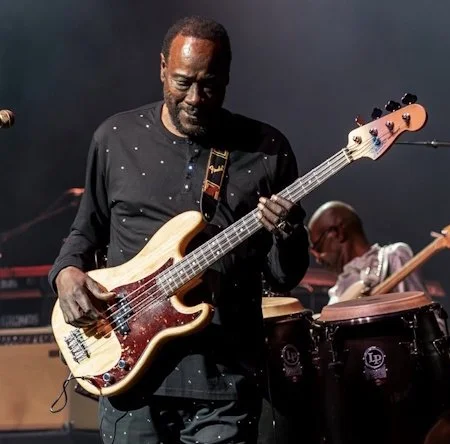
Ronald LaPread: talent, love, drama
The death on May 30 of the Commodores’ bassist, Ronald LaPread, brought those accomplishments back into circulation, as did the fact that they were essentially the first self-contained band at Motown, playing their own instruments, writing and performing their own material to creative and commercial acclaim: “Machine Gun,” “Slippery When Wet,” “Sweet Love,” “Just To Be Close To You,” “Brick House,” “Three Times A Lady” and more.
Then there was the Persian woman who caught LaPread’s attention on a flight from Sydney to Auckland in 1986 – and with whom he subsequently lived happily ever after, thousands of miles from his American homeland. His funeral? It began with a prayer in the Maori language of his adopted country.
The recent round of obituaries mostly offered familiar facts about this talented musician: his origins, the Commodores’ early years, their advance to global stardom, the songs he wrote (with the group, and the likes of “Zoom” with Lionel Richie), the detail of their popularity.
After stars have left the public eye, their stories tend to be untold, unless there’s drama, crime (of one sort or another) or tragedy. In this case, a Kiwi broadcaster became one of LaPread’s dearest friends, who witnessed first-hand how the musician traded post-fame life in his Tuskegee, Alabama, hometown, for a quiet existence in a suburb of New Zealand’s most populous city, Auckland, for almost 40 years.
Actually, there was a bit of drama there. The boarding house which LaPread and his wife owned – one of several – was the scene of two mysterious deaths in 2018. It was a home for vulnerable, disadvantaged people; local police reportedly did not consider homicide as a cause. Then again, the former Commodore had been philanthropic before emigrating, he committed the profits from sales of a new recording, “Let’s Keep The Music Playing,” to needy children in Alabama.
The above-mentioned New Zealand broadcaster is Tim Roxborogh, who first met LaPread while at the Auckland University of Technology. “I was studying communications,” he told me, “and given an assignment to interview someone – anyone. I knew that Ron was living in Auckland, and I’d been a fan of the Commodores for years.” LaPread took the call, did the interview in person – and sufficiently well that “I got an ‘A’ on the assignment,” Roxborogh laughed.
A REASON TO CALL
Soon enough, the ambitious youngster developed a radio career, including a breakfast show on New Zealand’s Easy Listening i network. “There was a reason – music – to ring Ron up,” recalled Roxborogh. “Then when Michael Jackson died, or anytime there was a death of a major American entertainer, I would call him.
“He had this great talking voice, and this ability to be homespun and to drop names at the same time. You just felt you were listening to this wonderful, warm-hearted man who just intersected with the biggest names in entertainment. I would record with him, like, 90 minutes of stories, then I would edit them into 45- or 50-second chunks. Then every three months, I’d get him to record another batch of stories. We did that for a couple of years.” The pair co-hosted a weekly classic soul/R&B show on a station known as Easy Mix.
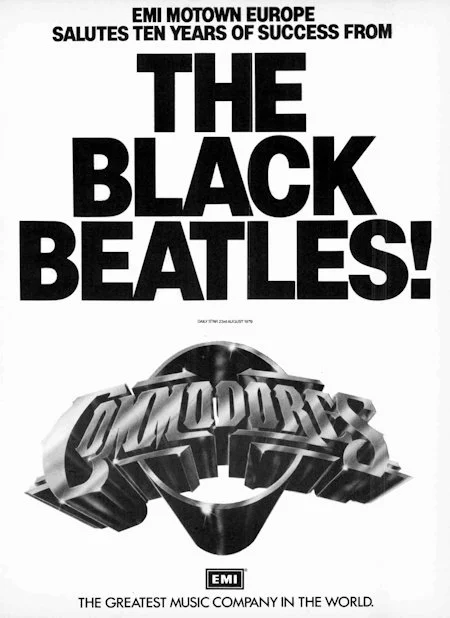
Conquering the world, whatever their name
LaPread had emigrated from the U.S. in 1987. He left the Commodores after their last major hit, “Nightshift,” but not before touring Australia and New Zealand with the group. On that trek, he met his future wife, Farideh, from a prominent Persian family, while flying between the two countries. “She had been married before,” said Roxborogh, “but her first husband, a surgeon in Auckland, had died. Ron said to her, ‘Come travel with me.’ She responded, ‘But I live in New Zealand.’ He said, ‘OK, come with me to the States for six weeks.’ ”
The couple’s subsequent marriage was LaPread’s fourth. His second wife had died tragically young, in 1977. “The Commodores had just left for a series of dates when [his] wife, Kathy Faye, became gravely ill with cancer,” Lionel Richie recalled in his autobiography, Truly. “We could have kept our engagements when Pread left to be at her side, but we decided to reschedule the rest of the tour and hurry home to be there for Pread and for Kathy, the most angelic young woman you’d ever want to know.” Her subsequent death inspired LaPread and Richie to write “Zoom.” Noted Richie in Truly, “And all of us felt Kathy’s spirit when we recorded it.”
Once permanently settled in New Zealand, LaPread kept his music connections, even while helping to manage his wife’s Persian rug business and their boarding houses. “Ron was always very comfortable financially,” Roxborogh said, “because the Commodores’ manager, Benny Ashburn, had fought for them to have a really good contract with Motown.” The bassist became part of a band with New Zealand musicians, “and there would be special performances where he’d appear.” In 2009, LaPread reunited with Richie and Commodores guitarist Thomas McClary for several U.S. shows, according to Roxborogh, including the Essence Music Festival in New Orleans that July.
“There was quite a feeling of accomplishment that after all those years, we were still able to come together and perform,” McClary elaborated in his own memoir, Rock And Soul. Later, when Richie took his solo tour to New Zealand, LaPread joined him on stage. “But rather than bringing out Ronald for a song or two, they did maybe six or seven or eight Commodores songs,” said Roxborogh, “and that’s really the closest they’ve been to a Commodores reunion.”
The broadcaster, who these days is also a music and travel writer, was shocked by LaPread’s death. “It was not expected,” he said. “We had talked about doing a book together – but he was always better as a storyteller in person, rather than having something written down.” Their final on-air interview took place in April 2025, “and the last time I saw him was three weeks before he died.
“Ron never said goodbye – he always said, ‘Peace.’ ”
Music notes: this Commodores playlist features songs written by Ronald LaPread with his bandmembers, as well as material he co-authored just with Lionel Richie (“Zoom,” “Fancy Dancer”), William King (“Young Girls Are My Weakness”) and by himself (“Look What You’ve Done To Me”).