A Hitsville Historian
‘AT LEAST TWO SIDES TO THE MOTOWN STORY’
Do you remember the first book about Motown that you read, and who wrote it?
Depending on your age, it might have been David Morse’s Motown & the Arrival of Black Music – the first of its type anywhere.
The modest, 110-page volume was published in the U.K. in 1971, and in the U.S. the following year. It was one of an initial quartet of so-called “rock books” from Studio Vista, edited by the late Phil Hardy. Cambridge-educated Morse went on to more academic topics, and in particular the culture and times of, er, the Victorian Age.
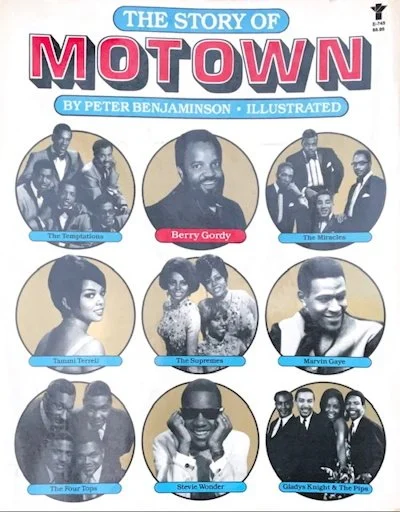
The book’s original 1979 edition
Motown & the Arrival of Black Music certainly contained information and perspectives which were new to some of us at the time, but was essentially a critic’s take on the music, rather than a history of Hitsville U.S.A. (It also contained at least one amusing error: Mickey Stevenson was described as Motown’s “art director,” presumably because someone misheard the phrase “A&R director.”)
The more significant, insightful book on the subject arrived eight years later, namely, Peter Benjaminson’s The Story of Motown, published by Grove Press. And this came to mind again because of the death of its author on November 12. He was 81.
Those who knew Peter will remember him as a most accomplished author, with deep experience in journalism and a remarkable appetite for not only the inner workings of Motown, but also for the life stories of two of its tragic heroines, Florence Ballard and Mary Wells. (In addition to those biographies, he wrote a book about one of its later, provocative stars, Rick James.)
The Story of Motown was reissued by Rare Bird Books in 2018, when I was in touch with Benjaminson for his recollections of the original edition (as per this West Grand Blog post) and his thoughts about the update. “The book is essentially the same as it was in 1979,” he noted, “except that I corrected the relatively minor mistakes that I made in the first edition, put the material contained in that edition’s footnotes into the main text of the second, and added a dynamite foreword by the nation’s best rock critic, Greil Marcus.”
In that foreword, Marcus described David Morse’s book as “a short, flat, circumscribed study,” while identifying some of the others which followed Benjaminson’s work, including Nelson George’s Where Did Our Love Go? (1985), Ray Singleton’s Berry, Me, and Motown (1990) and Gerald Posner’s Motown (2002). “For all that,” added Marcus, “The Story of Motown still delivers a charge you can find nowhere else. It’s the sense of excitement and suspense that comes with a tale being fully made public for the first time.” (Coincidentally, Benjaminson and Marcus attended the same high school and college in California, and are old friends.)

Peter Benjaminson: ‘breaking the racist dam’
Maryland-born Benjaminson was raised in the San Francisco Bay area and went to the University of California in Berkeley; there, he earned a degree in political science and began a career in writing and journalism. From 1970-76, he was a reporter for the Detroit Free Press, covering city government and local politics, and getting into investigative reporting “before it was actually called by that name.”
The result was a “how-to” book on that particular pursuit, written with a fellow Free Press reporter, David Anderson, and published in 1976. “To my surprise,” said Benjaminson, “the book sold well, and remained in print for 20 years. Hundreds of universities used it as a textbook.” This gave him a taste for writing about subjects that hadn’t previously attracted much attention from the publishing industry. “The Story of Motown pleased me greatly by falling into that category.
“One morning in 1975, while I was working on Investigative Reporting and still writing for the Freep, an editor told me that Flo Ballard was on welfare. I’d been a fan of Motown and the Supremes since the mid 1960s, when I was a college student. I assumed, along with millions of other fans, that Flo, even after leaving the Supremes, was living well – probably in Florida, spending the huge fortune she’d undoubtedly earned as a member of the world’s most successful female group.”
In the event, Ballard still lived in Detroit, and Benjaminson immediately got in touch to interview her. “The story I wrote for the Freep the next day was picked up nationally and internationally. It was the first indication for me and most other people that there were at least two sides to the Motown story.
“Flo and I decided that I’d write her biography. I went back to her several times after my initial story was published, interviewing her for several hours about her life. When I tried to sell the idea of a Flo bio to publishers, however, I was unable to do so, even though Investigative Reporting was successful.”
ADMIRATION FOR BERRY GORDY
Ballard’s death at age 32 in 1976 received national coverage, according to Benjaminson, “but publishers at the time, who were 99% white, weren’t much interested in books about black singers.” However, when the author moved from Detroit to New York that year, he found an executive at Grove Press – Barney Rosset – who liked the idea of a Ballard biography, but argued that it was premature because no comprehensive book had ever been published in America about Motown. In other words, readers wouldn’t have enough background about Berry Gordy’s business to appreciate the Ballard saga.
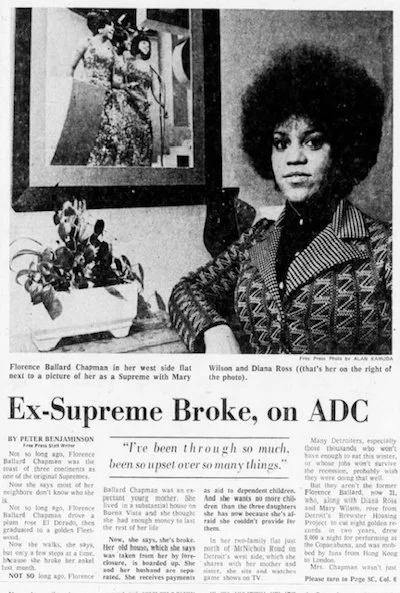
Peter Benjaminson’s original Detroit Free Press article in 1975 (ADC is “aid to dependent children”)
“Rosset said I should write The Story of Motown. I immediately glommed onto the idea,” said Benjaminson, “partly because I’d be once again writing a book that would have no or very little competition. And it apparently broke the racist dam, because at least 200 books have been written about Motown since it appeared.”
In retrospect, Benjaminson felt that his account of Hitsville U.S.A. was very fair to the company. “In fact, I had a great deal of admiration for Berry Gordy and for all of the creative people involved in it.” The book “was the first anywhere to detail Gordy’s upbringing and youth, his early business ventures, his founding of Motown, how it operated, the reasons for its success, and the reasons for its decline.
“I’m glad to be able to say that in researching and writing my three subsequent Motown books, I haven’t encountered anything contrary to what I wrote in The Story of Motown.”
Greil Marcus takes that point a little further: “Here is where Benjaminson’s experience as a crime reporter, street reporter, city reporter – privately employed, but as well a kind of public actor, with a debt to the truth owed to the public – comes into play.
“The Story of Motown doesn’t beg the question of whether it all really happened the way he says it did, because as he tells the story, that question fades against its answer: the fact that it happened at all.”
Rest in peace, Peter.